
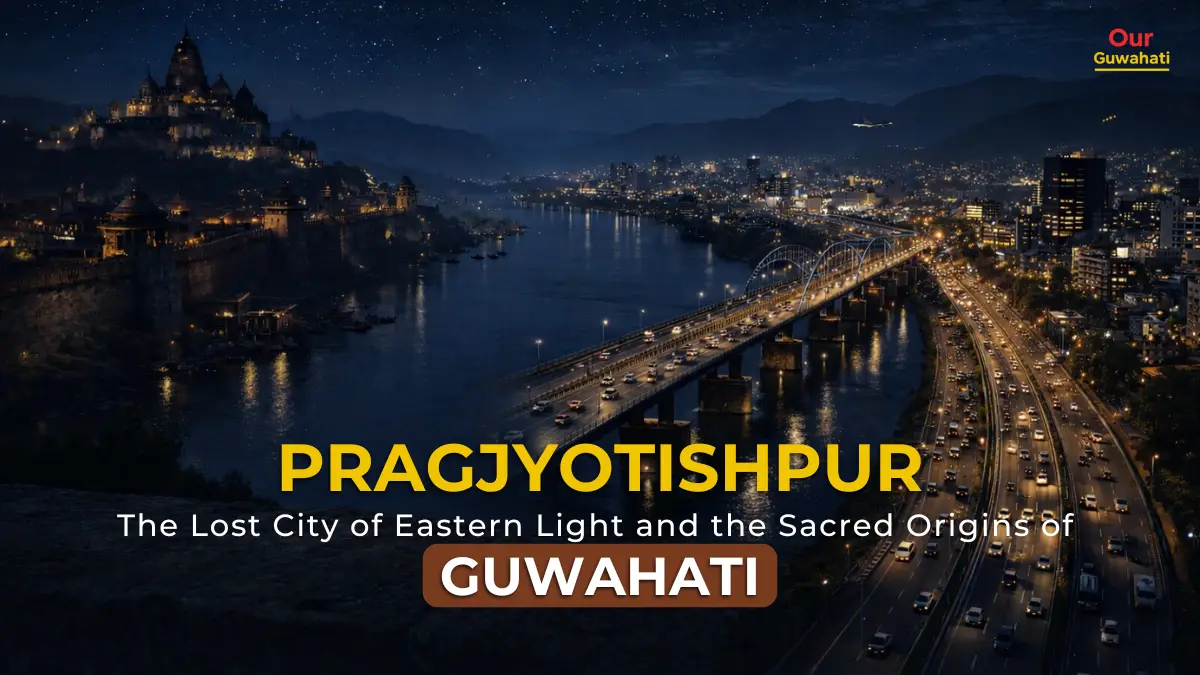
Long before Guwahati became the gateway to Northeast India, long before it emerged as a commercial and political center, the region was known by a name that sounded almost cosmic, Pragjyotishpur.
This was not merely a geographical label. It was a declaration. A statement about direction, light, power, and sacredness. In ancient literature, Pragjyotishpur was described as a powerful eastern kingdom, ruled by legendary figures and woven into epic narratives that shaped the civilizational memory of the Indian subcontinent. It was associated with fortified cities, celestial symbolism, and divine geography. It was not portrayed as a remote tribal frontier, but as a kingdom significant enough to participate in the grand political dramas of epic history.
Yet, the central question remains:
- Was Pragjyotishpur a real historical capital?
- Was it a mythic city imagined at the eastern edge of the known world?
- Or was it something more complex, a sacred political hybrid where mythology and statecraft merged?
Understanding Pragjyotishpur is not just about tracing the old name of Guwahati. It is about understanding how sacred geography becomes political authority, how myth shapes identity, and how a river valley transforms into a civilizational symbol.
In this article, we explore the meaning of the name, its location, its role in epic literature, its political use by later rulers, and the enduring questions that still surround it. By the end, Pragjyotishpur will no longer appear as a distant legend, but as a foundational idea that shaped the historical imagination of Assam.
What Does Pragjyotishpur Mean? The Linguistic and Cosmological Origin
To understand Pragjyotishpur, we must first understand its name. Ancient cities were rarely named casually. Their names often carried philosophical, geographical, and political meaning. Pragjyotishpur is one such name: layered, deliberate, and symbolic.
Breaking Down the Word
The term Pragjyotishpur can be divided into three Sanskrit components:
- Prag – meaning east
- Jyotish – meaning light, celestial knowledge, or astronomy
- Pura (Pur) – meaning city or fortified settlement
Put together, the name can be interpreted as:
“The City of Eastern Light”
or
“The Eastern City of Celestial Knowledge.”
This is not a simple topographical name like “river town” or “hill settlement.” It is cosmological. It situates the city in relation to direction, light, and possibly astronomical understanding.
The east in ancient Indian thought was not just a direction. It was sacred. It was the direction of sunrise, of beginnings, of illumination. Rituals were performed facing east. Temples were aligned toward the rising sun. In Vedic cosmology, the east symbolized awakening and knowledge.
Calling a city “Pragjyotishpur” therefore does something powerful: it frames the region as the place where light rises, geographically, spiritually, and symbolically.
Why “Jyotish” Matters
The word jyotish adds another dimension. It does not only mean light in a physical sense. It is associated with astronomy, astrology, and celestial science. In classical Indian traditions, jyotisha was one of the key branches of knowledge. It connected earthly events to cosmic order.
This has led some scholars to suggest that Pragjyotishpur may have been imagined as a center of celestial learning or cosmic alignment. Whether this was literally true or metaphorical remains debated, but the naming indicates that the city was conceived as being aligned with cosmic order.
In other words, the name does not describe the landscape alone — it elevates it into a sacred and intellectual sphere.
The Frontier of the Known World
There is another important dimension to the word “Prag” (east). In early epic geography, regions to the far east were often portrayed as distant, mysterious, and powerful. They were the edges of the known cultural world. Describing a kingdom as located in the “east” positioned it at the frontier of civilization, both remote and significant.
Pragjyotishpur, therefore, was imagined as:
- The eastern frontier of political power
- A luminous land at the edge of the known world
- A kingdom distinct yet integrated into the broader civilizational map
This duality, distant yet central, gives the name its strength.
A Name That Creates Identity
Names can shape perception. By the time Pragjyotishpur appears in literary memory, it is already charged with meaning. It is not introduced as an obscure settlement. It is presented as a fortified and organized kingdom, one that participates in epic political events.
This suggests that the name may have served an identity-building function. It transformed a geographical region into a civilizational space.
Whether the name was originally mythic and later applied to a real city, or whether a real city was poetically elevated through literature, the effect remains the same: Pragjyotishpur became more than territory. It became narrative.
Between Language and Landscape
When we look at present-day Guwahati, surrounded by hills and embraced by the Brahmaputra, the symbolic reading gains further depth. The rising sun over the eastern hills, reflected in the river, fits the poetic imagery of “Eastern Light.” Whether intentional or coincidental, the geography supports the metaphor.
But at this stage, we must remain cautious. Linguistic meaning does not automatically confirm historical reality. The name tells us how the region was imagined. It does not, by itself, prove whether the city existed exactly as described in epics.
What it does prove is this: Pragjyotishpur was never conceived as ordinary. From its very name, it was a place where geography met cosmology, where direction, light, and power were intertwined.
Was Pragjyotishpur a Myth or a Real Capital?
This is the question that decides how we should read everything that comes next.
If Pragjyotishpur was purely myth, then it belongs to the realm of epic imagination, a poetic “eastern kingdom” used to make stories larger-than-life.
If it were purely historical, then it is the earliest political identity of the Guwahati region, a real capital whose memory survived through sacred texts.
But Guwahati’s story (and Assam’s story in general) rarely fits into such clean binaries. The most honest answer is that Pragjyotishpur sits in the middle zone where myth and history overlap, where literature preserves political memory, and politics borrows sacred legitimacy.
To understand this, historians and scholars usually work with three models.
Theory 1: Pragjyotishpur as Purely Mythic Geography
Under this view, Pragjyotishpur is primarily a literary location. Epic traditions often speak about distant kingdoms at the edges of the known world:
- the far north as mysterious mountain realms
- the far west as lands of ocean and trade
- and the far east as lands of sunrise, power, and unusual kings
In such narrative geography, “east” becomes a symbolic direction rather than a GPS coordinate. A kingdom described as eastern is meant to sound distant and formidable, even if the audience cannot precisely map it.
So, Pragjyotishpur can be read as:
- a mythic frontier kingdom
- a storytelling device that expands the epic world
- a symbolic location representing “the east” as an idea
Why this theory exists:
Because the earliest references are not inscriptions or government records. They are literary narratives. Epic literature often compresses centuries, combines legends, and turns regions into archetypes.
What this theory explains well:
- Why descriptions can feel larger-than-life
- Why the kingdom is sometimes portrayed with dramatic power
- Why exact geography is not always consistent
Where it falls short:
It struggles to explain why Pragjyotishpur becomes so persistent across traditions. Many purely fictional locations appear once and vanish. Pragjyotishpur doesn’t vanish. It stays, and keeps gaining weight in later texts and regional identity.
That persistence suggests it was anchored to something real.
Theory 2: A Real Political Capital Later Wrapped in Myth
This theory flips the direction of influence.
Instead of myth creating a kingdom, history creates a kingdom — and later writers wrap it in myth.
This pattern is extremely common in the Indian subcontinent:
- Ancient cities gain epic origin stories
- Kings claim divine ancestors
- Historical capitals get mapped onto sacred landscapes
- Local power gets “upgraded” into pan-Indian legitimacy
Under this model, Pragjyotishpur begins as:
- a historical political center in the eastern region
- later identified with Guwahati / Kamrup region
- then elevated through literature and religious tradition
In other words:
A real city becomes an epic city.
Why rulers would want this:
Because sacred antiquity gives authority. If your kingdom is described in epics, your rule is not temporary; it feels eternal. It turns politics into destiny.
And when you’re in a region far from the early Indo-Gangetic political core, epic anchoring becomes even more useful. It integrates you into the larger civilizational map.
What this theory explains well:
- Why later Assam rulers connect themselves to epic lineages
- Why “Pragjyotishpur” becomes a proud identifier
- Why sacred sites like Kamakhya become politically central
Where it becomes tricky:
You still need some historical evidence that such a capital functioned continuously in the way later tradition suggests. And in the case of Pragjyotishpur, we do not have a single, direct “labelled” inscription that says: this capital is Pragjyotishpur.
So this model is plausible, but not conclusively provable.
Theory 3: A Sacred-Political Hybrid
This is the most balanced, and honestly, the most realistic reading. In this model, Pragjyotishpur is not “either myth or history.” It is:
- a real region with early political organization
- remembered and described through sacred narrative
- repeatedly reinterpreted by later rulers and texts
A hybrid identity emerges like this:
- A region becomes politically important early on
- That importance becomes encoded into legend
- The legend becomes sacred memory
- Later political powers use that memory as legitimacy
- Over centuries, myth and political identity fuse
This is how sacred capitals behave across the world, not just in India. A sacred-political hybrid city is one where:
- geography supports settlement and defense
- religion creates continuity
- narrative gives the place a larger meaning
- political authority uses sacred status to stabilize rule
Pragjyotishpur fits this pattern unusually well, because the Guwahati region has all four components:
- Geography: Brahmaputra + hills = defensible and fertile zone
- Religion: Kamakhya and related sacred landscape traditions
- Narrative: epics and later texts framing the region as ancient and powerful
- Politics: later dynasties leveraging lineage, myth, and sacred patronage
This hybrid model also explains why, even today, people talk about Pragjyotishpur not as a “fictional place,” but as an ancestral identity of the region.
So, What Should We Believe?
If we want to stay rigorous, the best stance is:
- Treat Pragjyotishpur as a historical possibility supported by strong cultural continuity,
- but acknowledge that its earliest references are literary, not epigraphic,
- and that later politics almost certainly amplified and institutionalized the myth.
So a careful, honest conclusion would be:
Pragjyotishpur is best understood as an ancient regional identity that became sacred geography, and later evolved into political legitimacy.
It is not “just a legend.” But it is also not a fully proven, neatly documented capital in the way later historical capitals are. It is a city that lived in memory first, and in stone later.
Where Was Pragjyotishpur Located? Was It Present-Day Guwahati?
After understanding the meaning of the name and the debate around its reality, the next logical question is geographical: If Pragjyotishpur existed, where exactly was it?
Most scholars, historians, and regional traditions associate Pragjyotishpur with the area around present-day Guwahati, particularly the Nilachal Hill and the surrounding Brahmaputra valley. But this identification is based on layered reasoning, not a single conclusive inscription.
Let us break this down carefully.
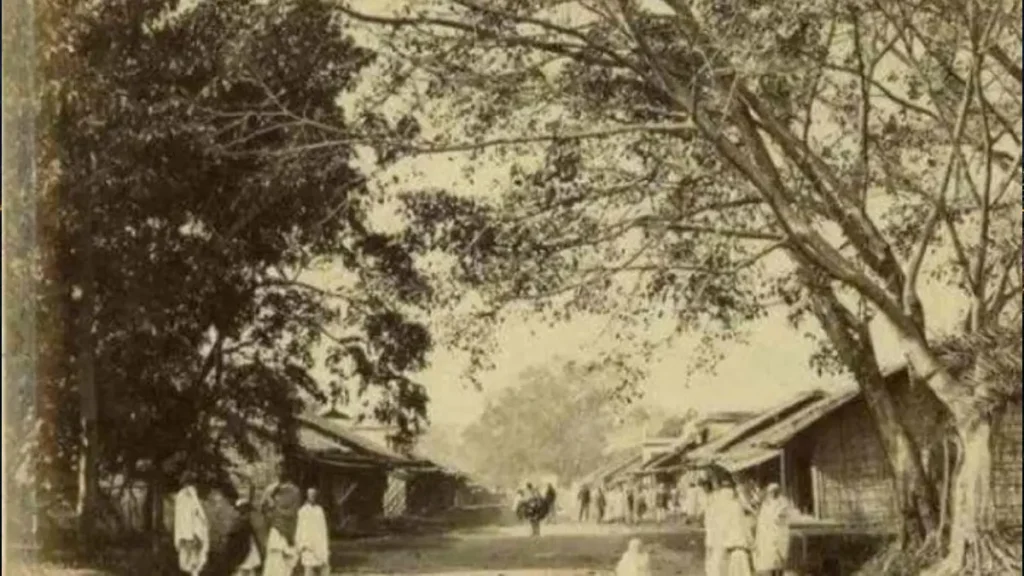
The Guwahati Hypothesis: Why This Region?
The strongest identification of Pragjyotishpur is with the ancient core of the Kamrup region, centered around modern Guwahati. This association rests on several interconnected observations.
1. Sacred Continuity
The region around Guwahati has maintained uninterrupted sacred importance for centuries. The Nilachal Hill, where the Kamakhya Temple stands today, has been a ritual center long before medieval temple reconstruction.
Sacred centers tend to survive political collapse. When kingdoms fall, capitals may shift — but sacred geography often remains fixed. The persistence of ritual importance in this specific location strengthens the argument that the epic memory of Pragjyotishpur may have been attached to this very landscape.
2. Strategic Geography
Look at Guwahati geographically:
- Surrounded by hills on multiple sides
- Located along a narrow stretch of the Brahmaputra
- Naturally defensible
- Positioned at a river choke point
If you were to establish a fortified eastern capital in ancient times, this terrain would be ideal. Epic descriptions often mention fortified settlements, and Guwahati’s geography aligns surprisingly well with such imagery. The city is not just scenic, it is structurally strategic.
3. Later Political Centers
When we move into early historical periods (which we will study later in detail), the region around Guwahati emerges as an important political zone under the Kamarupa kingdom.
Even if capitals shifted over time, the Guwahati region consistently appears in administrative, religious, and strategic contexts. This continuity makes it unlikely that Pragjyotishpur referred to a completely different, lost location far from here.
What Evidence Exists?
It is important to be precise here. We do not have:
- An inscription from 2000 years ago stating, “This is Pragjyotishpur.”
- A clearly excavated palace complex labeled with the epic name.
What we do have is layered cultural and historical alignment:
- Literary references place Pragjyotishpur in the far eastern region of the subcontinent.
- Later dynasties of Kamarupa identify themselves with the epic legacy of that region.
- Sacred sites in and around Guwahati are continuously associated with those traditions.
- Regional memory never relocates Pragjyotishpur elsewhere.
When multiple strands, literary, political, and religious, converge on the same geographical area, historians consider that convergence significant.
The Role of Nilachal Hill
Nilachal Hill plays a central role in this identification. It is not just a hill with a temple. It is a symbolic axis:
- Elevated terrain overlooking the river
- A natural defensive advantage
- A ritual high point
Sacred hills in ancient India often functioned as both religious and administrative centers. In many early polities, political authority and ritual authority were intertwined. If the epic memory speaks of a fortified eastern capital and the strongest surviving sacred center in the region is here, the overlap becomes difficult to ignore.
Nilachal may not have been the entire city, but it likely formed the symbolic heart of the region.
Could Pragjyotishpur Have Been Elsewhere?
This is an important question. Some scholars suggest that the epic geography may have referred broadly to the entire eastern Kamarupa region rather than a single urban settlement. In this reading, Pragjyotishpur could have been:
- A regional political zone
- A loose confederation of settlements
- Or a shifting capital within a larger territorial framework
Ancient capitals were not always fixed cities with permanent stone architecture. Many early centers were semi-mobile, seasonal, or expanded gradually.
So it is possible that “Pragjyotishpur” referred not to a single walled city in the modern sense, but to a broader eastern capital region anchored around what later became Guwahati.
Literary Geography vs Archaeological Geography
This distinction matters. Literary geography:
- Often compresses distances
- Uses symbolic exaggeration
- Describes kingdoms in terms of power rather than precise mapping
Archaeological geography:
- Requires physical remains
- Demands datable material
- Works with evidence, not narrative
Pragjyotishpur primarily appears in literary geography. But when literary descriptions align strongly with a historically continuous and strategically logical location, scholars consider that alignment meaningful.
Guwahati fits the literary description better than any other known site in the Brahmaputra valley.
Why Guwahati Makes the Strongest Case
If we weigh the evidence carefully, Guwahati stands out because:
- It sits at a strategic eastern frontier of early Indo-Aryan political imagination.
- It maintains continuous sacred identity through Kamakhya and related traditions.
- It later becomes central in the Kamarupa kingdom.
- Regional historical memory consistently associates it with Pragjyotishpur.
There is no competing location with equally strong continuity. That does not mean the identification is 100 percent proven. It means it is the most coherent explanation based on available data.
A City Between Memory and Terrain
So where was Pragjyotishpur? The safest and most academically honest answer is:
It was very likely centered around the present-day Guwahati region particularly the Nilachal Hill and surrounding Brahmaputra valley, but its exact urban boundaries remain unknown.
It may have been:
- A fortified capital,
- A sacred-political zone,
- Or a broader regional designation anchored here.
What matters is this:
The geography of Guwahati, river, hills, defensible terrain, sacred continuity, fits the epic imagination unusually well.
The land supports the legend.
Pragjyotishpur in Ancient Epics – A Kingdom That Mattered
Once we step into epic literature, Pragjyotishpur stops being a linguistic idea and becomes a political presence. It is not described as a vague eastern land. It appears as a kingdom, ruled, fortified, and powerful enough to influence the larger narrative of the subcontinent.
This is important.
Epic texts did not casually include distant regions unless those regions had symbolic or political weight. The appearance of Pragjyotishpur in epic memory tells us that, at the very least, the eastern frontier was imagined as a structured and formidable realm.
Let us understand this at a foundational level before diving into text-by-text analysis later.
A Fortified Eastern Kingdom
In epic narratives, Pragjyotishpur is associated with strong fortifications and formidable rulers. It is not portrayed as a peripheral tribal zone without organization. Instead, it appears as a recognized political entity.
Descriptions emphasize:
- Defensive strength
- Military capability
- Distinct regional identity
- Integration into broader subcontinental politics
That portrayal alone reshapes how we must think about ancient Assam. The region is not treated as an isolated wilderness; it is embedded in a wider civilizational map.
The Rulers of Pragjyotishpur
The kingdom is most famously associated with Narakasura and later Bhagadatta. Even without going deep into textual breakdowns yet, what matters is this:
- Narakasura is described as a powerful ruler of the eastern realm.
- Bhagadatta, in later narratives, is depicted as a warrior king participating in major epic conflicts.
Participation in epic wars is not a minor detail. It implies recognition. It implies that the eastern kingdom was considered strong enough to matter in the balance of power.
In narrative logic, only significant kingdoms get invited into epic-scale wars.
The Eastern Frontier in Epic Imagination
Ancient epics often structured the subcontinent into directional realms:
- The north associated with mountains and sages
- The west associated with maritime trade and distant lands
- The south with forests and powerful dynasties
- The east with sunrise, elephants, and formidable warriors
The east, especially, was portrayed as:
- Distant yet wealthy
- Culturally distinct yet politically integrated
- Militarily strong
Pragjyotishpur becomes the anchor of that eastern imagination.
This matters because epic geography was not random. It reflected how early societies conceptualized power distribution across the subcontinent.
Integration into the Civilizational Network
The inclusion of Pragjyotishpur in epic narratives performs a subtle but powerful function: It integrates the Assam region into the civilizational mainstream.
Instead of being excluded, the eastern frontier is acknowledged. It participates. It has rulers, armies, alliances, and rivalries. For later generations in Assam, this had enormous significance.
If your land appears in the epic map of India, your history is not marginal. It is foundational. This is one reason why the memory of Pragjyotishpur remained alive, it was a civilizational credential.
Political Messaging Embedded in Epic Narratives
Epic literature is not neutral storytelling. It carries ideological messaging. When a distant kingdom is portrayed as powerful but eventually integrated into the broader political order, the message is layered:
- It recognizes regional strength.
- It situates that strength within a unified moral universe.
- It transforms geography into narrative destiny.
In this sense, Pragjyotishpur in epic texts serves both as:
- A marker of regional identity,
- And a bridge connecting that identity to the pan-Indian framework.
A Kingdom, Not a Mythical Island
It is also important to note what Pragjyotishpur is not. It is not portrayed as:
- A floating celestial city,
- A mythical underwater realm,
- Or a purely supernatural domain.
It is a terrestrial kingdom. That grounded portrayal strengthens the argument that epic memory may be preserving echoes of real political formations, even if wrapped in legendary detail.
Why This Section Matters
The epic presence of Pragjyotishpur does three things:
- It places the Assam region within the earliest literary memory of the subcontinent.
- It establishes the eastern frontier as politically organized and militarily capable.
- It provides later rulers with a ready-made narrative of antiquity and legitimacy.
In short, the epics do not prove the exact historical structure of Pragjyotishpur, but they confirm that the region was never imagined as irrelevant. It was powerful enough to be remembered.
The Political Use of Sacred Geography – How Pragjyotishpur Became Legitimacy
If Pragjyotishpur had remained only an epic reference, it would have faded into literary memory like many other ancient names. But it did not fade. Instead, it was adopted, reinforced, and strategically used by later rulers of the region.
This is where mythology transitions into statecraft.
Sacred geography is never politically neutral. When a land is described as ancient, luminous, divinely connected, and epic-worthy, it becomes more than territory, it becomes authority. Control over such a place is not just administrative; it is symbolic.
Pragjyotishpur became a powerful political asset because it linked rulers to cosmic history.
Myth as a Tool of Statecraft
Throughout history, political authority has often sought sacred validation. Kings do not simply rule by force; they rule by narrative. They align themselves with gods, heroes, and legendary ancestors to create continuity between mythic time and present governance.
In the case of Assam’s early historical rulers, especially those of the Kamarupa region, this pattern is visible. Later dynasties:
- Claimed descent from legendary figures associated with the eastern kingdom.
- Linked themselves to the epic identity of Pragjyotishpur.
- Reinforced their authority by invoking sacred antiquity.
This was not accidental. It was strategic.
If your kingdom can be traced back to a name that appears in ancient epics, then your rule is not recent or temporary; it is part of a cosmic continuum. Sacred memory becomes political stability.
The Role of Lineage and Descent
One of the most powerful ways rulers legitimize themselves is through lineage. By associating themselves with legendary rulers of Pragjyotishpur, later kings were able to:
- Connect regional authority to epic history.
- Elevate local power into civilizational significance.
- Strengthen internal loyalty through shared ancestral pride.
This technique was widely used across ancient India. Dynasties often traced their origins to solar or lunar lineages described in epics. In the eastern frontier, linking to Pragjyotishpur performed a similar function.
It signaled:
We are not outsiders. We are inheritors.
Kamakhya and the Sacred Axis of Power
Sacred geography in the Guwahati region is deeply tied to the Nilachal Hill and the Kamakhya shrine. Even without diving fully into its tantric and religious complexities yet, one fact is clear:
The sacred center and the political center were geographically intertwined.
In many early polities, control over the primary ritual site was equivalent to political dominance. Temples were not only places of worship, but they were also economic hubs, landholding institutions, and symbols of divine sanction.
By patronizing sacred institutions in the region associated with Pragjyotishpur, rulers achieved multiple objectives:
- Religious endorsement of their authority
- Public demonstration of piety
- Integration of diverse communities under a shared sacred identity
The hill, the river, and the epic memory together created a powerful symbolic triangle.
Sacred Cities and Political Continuity
Why do sacred cities survive longer than political capitals?
Because even when administrations shift, sacred memory anchors identity. When regimes fall, temples remain. When armies retreat, ritual continues.
This endurance allows sacred geography to outlast dynasties. Pragjyotishpur’s strength as an idea lies in this continuity. It was not dependent on a single king or empire. It was embedded in cultural consciousness.
Later rulers could collapse, but the sacred narrative remained available for revival. That makes sacred geography one of the most durable forms of political capital.
Integrating the Frontier into Civilization
There is another political dimension worth considering.
The eastern region was geographically distant from the early Indo-Gangetic political heartlands. To ensure legitimacy within a broader civilizational framework, rulers in the region needed narrative integration. Pragjyotishpur performed that integration.
By appearing in epic tradition, the eastern kingdom was not marginal, it was included. This inclusion provided later rulers a ready-made bridge between local governance and pan-Indian identity.
In effect, sacred geography erased the idea of isolation.
It declared:
The east is not peripheral, it is primordial.
Why This Matters for Guwahati
Understanding the political use of Pragjyotishpur changes how we see Guwahati.
It was not simply a trade node on the Brahmaputra.
It was not only a strategic hill-fort settlement.
It was a landscape whose authority was sanctified through narrative.
When sacred geography and political power overlap, the city becomes more than administrative space. It becomes symbolic territory. This symbolic capital can influence identity for centuries.
The Silent Strategy
There was no formal proclamation saying, “We are using Pragjyotishpur for legitimacy.” Political strategies in ancient times were rarely declared so plainly. But the pattern is visible:
- Epic references establish antiquity.
- Sacred sites provide continuity.
- Rulers adopt lineage and patronage.
- The region’s identity solidifies around mythic memory.
This quiet alignment between myth and power is what transforms a name into an institution. Pragjyotishpur was not only remembered, it was mobilized.
Why Pragjyotishpur Matters in Understanding Guwahati Today
At this point, it may seem that Pragjyotishpur belongs to a distant past, an ancient name, embedded in epic memory and political mythology. But its significance does not end in antiquity. In fact, understanding Pragjyotishpur changes how we understand Guwahati itself.
Without Pragjyotishpur, Guwahati is simply a strategic river city.
With Pragjyotishpur, Guwahati becomes a civilizational landmark.
That distinction is profound.
From Geography to Civilizational Identity
Every city has geography. Few cities have mythic memory layered onto that geography. Pragjyotishpur transforms the Brahmaputra valley from a physical landscape into a symbolic space. It frames the region not as a peripheral frontier, but as an ancient eastern axis of power and sacredness. This matters because identity shapes continuity.
When a region can claim:
- Epic references,
- Sacred hills,
- Legendary rulers,
- And political continuity,
it gains depth. It becomes rooted.
Pragjyotishpur provides Guwahati with that depth.
Connecting Assam to the Larger Civilizational Map
One of the most important roles of Pragjyotishpur is integration.
The Assam region is geographically separated from much of the Indian subcontinent by terrain and river systems. Historically, it developed unique cultural patterns. Yet, through the memory of Pragjyotishpur, the region is firmly embedded in the wider narrative of the subcontinent.
The inclusion of Pragjyotishpur in epic literature creates a bridge. It signals that the eastern frontier was not an afterthought, it was present in the earliest layers of shared cultural storytelling.
This has long-term implications.
It allows Assam’s history to be read not as an isolated regional story, but as part of a larger civilizational arc.
Explaining Sacred Continuity in Guwahati
If we observe Guwahati today, certain patterns stand out:
- The prominence of Nilachal Hill
- The enduring importance of sacred ritual
- The deep intertwining of religious identity and regional pride
These are not random features of modern culture. They are echoes of an older identity.
The memory of Pragjyotishpur helps explain why sacred geography in this region is so resilient. It was never simply local worship. It was part of a larger narrative of eastern luminosity and power.
That symbolic foundation gives religious continuity unusual strength.
The Idea of the “Eastern Light”
The phrase embedded in the name, “City of Eastern Light” continues to resonate metaphorically.
The east is where the sun rises. It represents beginnings. In the epic imagination, the eastern frontier was both distant and foundational. It was the place where light entered the subcontinent.
This metaphor subtly elevates the region’s self-perception. It shifts the psychological framework from marginality to primacy.
Guwahati, through Pragjyotishpur, is not the edge of something. It is the beginning of something. That symbolic repositioning influences cultural confidence across generations.
Memory as Infrastructure
Cities are built not only with stone and roads, but with memory. Political capitals rise and fall. Trade routes shift. Administrative centers relocate. But narrative memory often outlasts these changes.
Pragjyotishpur acts as a kind of invisible infrastructure, a foundational layer beneath the modern city. It stabilizes identity across time.
When later kingdoms emerged in the region, when colonial restructuring altered administrative importance, and even when modern urbanization transformed the skyline, the ancient name continued to provide continuity. That continuity is rare.
Why It Matters in Historical Study
From a scholarly perspective, Pragjyotishpur forces us to ask deeper questions:
- How does myth preserve political memory?
- When does sacred geography become historical geography?
- Can epic narratives contain fragments of real state formation?
Studying Pragjyotishpur encourages careful balance. It prevents us from dismissing ancient texts as pure fiction, while also preventing us from accepting them uncritically. It invites disciplined curiosity.
A Foundation, Not a Footnote
Too often, early eastern polities are treated as side notes in broader histories. Pragjyotishpur challenges that framing.
Its persistent appearance across texts and traditions suggests that the eastern region was structurally important much earlier than many simplified historical narratives acknowledge.
Instead of being a marginal appendix, the region appears as a fortified, organized, and sacred frontier. That reframes Guwahati’s historical trajectory entirely.
From Pragjyotishpur to Guwahati
Modern Guwahati is a commercial hub, a transportation corridor, and a political center for the Northeast. Yet beneath that modern identity lies an older, quieter layer.
Pragjyotishpur is not just an ancient name, it is the seed identity from which later formations grew.
Understanding this allows us to see Guwahati not as a city that suddenly rose in importance during medieval or colonial periods, but as a landscape whose significance was imagined and institutionalized thousands of years ago. That imagination mattered.
What We Still Do Not Know – The Gaps, Debates, and Unanswered Questions
A good historical study does not only tell stories, it also clearly marks the edge of certainty.
Pragjyotishpur is powerful precisely because it sits on that edge: between narrative memory and material history, between sacred geography and political geography. And because it sits there, there are things we can say with confidence, and things we must treat as open questions.
This section matters because it keeps the blog intellectually honest.
1. The Biggest Gap: Literary Memory vs Physical Proof
The earliest references to Pragjyotishpur come from literary and sacred traditions, not from inscriptions, coins, or excavated city-plans. That means:
- We can confirm that the name existed in cultural memory.
- We can confirm it had political and symbolic weight in epic imagination.
- But we cannot confirm its exact historical form the way we can confirm later dynastic capitals.
This is the core gap:
Literature describes Pragjyotishpur vividly. Archaeology has not yet provided a direct label.
So any attempt to map Pragjyotishpur precisely onto modern Guwahati remains interpretative.
2. We Still Don’t Know the Exact Boundaries of “Pragjyotishpur.”
Even if we accept that the Guwahati region is the strongest candidate, we still do not know:
- How large Pragjyotishpur was
- Whether it was a single-walled city or a cluster of settlements
- Whether “Pragjyotishpur” referred to a capital city or a broader region
- How far did it extend across the Kamrup belt
Ancient “cities” were not always like modern cities. Some were:
- temple-centric settlements
- hill-fort administrative cores
- trade settlements that expanded and shrank with political cycles
So a major open question is:
Was Pragjyotishpur a city in the strict urban sense, or a regional capital identity anchored in Guwahati?
3. No Single Inscription Yet Says: “This is Pragjyotishpur.”
This point needs to be stated plainly. We do not currently have a widely accepted archaeological discovery like:
- a copper plate grant explicitly naming the capital as Pragjyotishpur in the Guwahati zone, or
- a stone inscription on a fort wall stating the city name.
There are inscriptions and grants from Kamarupa dynasties (which we’ll cover later), but the direct “Pragjyotishpur = this site” label is not the kind of clean evidence historians love.
That’s why scholarly writing often uses careful language:
“associated with,” “identified with,” “traditionally linked to,” rather than “proven.”
4. Myth and History Were Blended on Purpose
Another reason certainty becomes difficult is because myth and history were intentionally merged. Rulers did not just “inherit myths.” They actively used them.
So when later dynasties associate themselves with epic lineages, the question becomes:
- Are we seeing preserved memory of a real ancient polity?
- Or are we seeing political mythology manufactured to legitimize rule?
The truth can be either, or both.
This is why Pragjyotishpur is so complex: It is not only a question of evidence, but also a question of political intent.
5. Epic Geography Often Uses Symbolic Distance
Epics frequently describe locations using symbolic language:
- “far east”
- “fortress-like cities”
- “mighty kings”
These descriptions may be based on real regions, but they are not written as geographic surveys.
So even if Pragjyotishpur refers to Assam, epic geography may still:
- exaggerate scale
- compress distances
- stylize cultural traits
- merge multiple local traditions into one narrative kingdom
This means we have to read epics carefully: as cultural memory, not as modern cartography.
6. What We Can Say Responsibly
Even with the gaps, a few things are reasonable to state:
- Pragjyotishpur was not a minor or throwaway name in ancient literature.
- It carried strong symbolic meaning tied to “east” and “light/celestial order.”
- It was remembered as a politically significant eastern kingdom.
- The Guwahati region is the strongest and most coherent candidate for its location.
- Later rulers and sacred traditions reinforced this identity over centuries.
So the honest conclusion is:
Pragjyotishpur is historically plausible, culturally continuous, and politically meaningful, but not archaeologically “closed” as a case.
Why the Uncertainty Doesn’t Make It Less Important
Some readers assume that if something is not 100% proven, it is irrelevant. That is a modern misunderstanding. In early history, especially in regions where archaeology is still developing, many foundational identities exist first in texts, memory, and ritual continuity.
Pragjyotishpur is one such identity.
Its power lies not only in “proof,” but in the fact that it shaped:
- how the region imagined itself
- how rulers legitimized authority
- how sacred geography anchored continuity
- how Guwahati became more than a city, a civilizational idea
In a historical study, that shaping force is itself evidence of significance.
Conclusion
Pragjyotishpur is not easy to categorize. It resists simple definitions. It is neither fully mythical nor fully documented in the rigid way modern historians prefer. Instead, it exists in a powerful in-between space, where landscape, legend, and legitimacy intersect.
From its very name, City of Eastern Light, Pragjyotishpur signals that it was imagined as more than a settlement. It was framed as a cosmic frontier, a luminous eastern axis in the mental map of ancient India. Whether that imagination began with poetry and later attached itself to real political centers, or whether it emerged from an early historical capital that was later elevated into epic memory, the result is the same: the region around present-day Guwahati acquired civilizational depth.
When epic narratives describe a fortified eastern kingdom, when later rulers claim descent from its legendary lineages, and when sacred geography around Nilachal Hill continues uninterrupted across centuries, we are not looking at coincidence. We are looking at continuity, layered, interpreted, and politically mobilized across time.
Pragjyotishpur matters because it transforms Guwahati from a strategic river settlement into a remembered capital of light. It integrates Assam into the wider civilizational imagination of the subcontinent. It explains why sacred geography and political authority remained intertwined in this region. And it reminds us that cities are built not only with stone and infrastructure, but with narrative.
Even where archaeology has not provided final confirmation, memory has persisted. And sometimes, in early history, persistence itself is meaningful.
Pragjyotishpur is not just an ancient name for Guwahati. It is the earliest layer of its identity, the foundation beneath later dynasties, colonial restructuring, and modern urban growth.
Before Guwahati became a gateway, it was imagined as the dawn.
Frequently Asked Questions
Pragjyotishpur is widely associated with the region around present-day Guwahati, particularly the Nilachal Hill and Brahmaputra valley. While there is no single inscription conclusively labeling modern Guwahati as Pragjyotishpur, literary, political, and sacred continuity strongly support the identification.
The name is derived from Sanskrit components:
Prag – East
Jyotish – Light or celestial knowledge
Pura – City
It is generally interpreted as “City of Eastern Light” or “Eastern City of Celestial Knowledge.”
It was most likely a sacred-political hybrid. It appears in ancient literature as a powerful eastern kingdom. While direct archaeological confirmation is limited, historical continuity and later dynastic associations suggest that it was rooted in a real political region.
Epic narratives associate the kingdom with legendary rulers such as Narakasura and Bhagadatta. These figures play roles in larger epic conflicts, suggesting that the eastern kingdom was imagined as politically significant.
Pragjyotishpur provides Assam with deep antiquity in civilizational memory. It integrates the region into epic tradition, explains the sacred importance of Guwahati’s landscape, and shows how myth and political authority merged in early state formation.
There is no direct archaeological inscription explicitly identifying a site as Pragjyotishpur. However, the Guwahati region aligns strongly with literary descriptions and later historical continuity. Scholars consider it historically plausible but not conclusively proven.