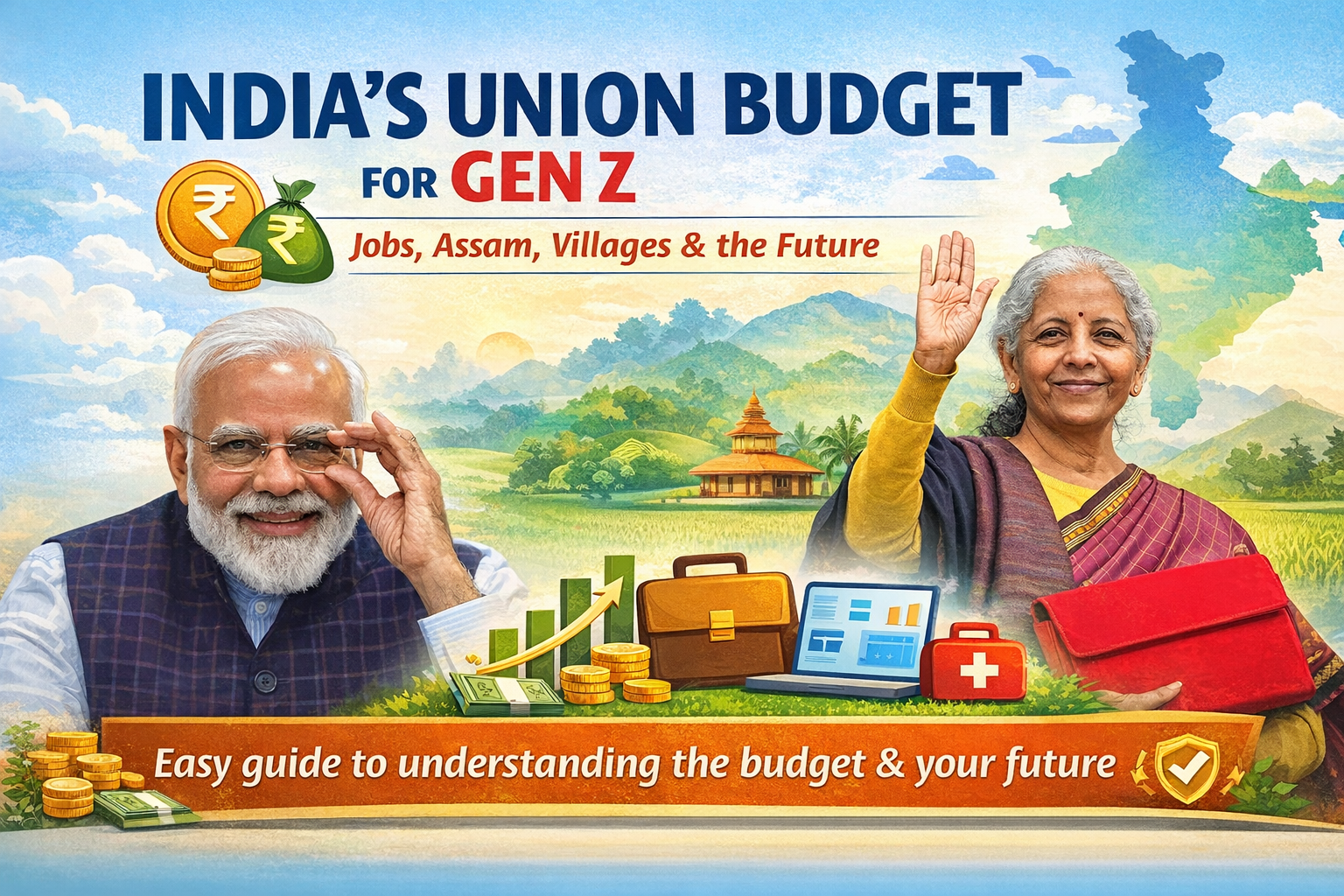
India’s Union Budget 2026-27 can feel confusing, especially if you’re not an economist or finance expert. This guide breaks down the budget in simple, easy-to-understand language for Gen Z students, job seekers, freelancers, and young entrepreneurs. From jobs and skills to Assam, villages, healthcare, tourism, technology, and future opportunities, this explanation focuses on what truly matters in everyday life. Think of it as a clear, practical roadmap to understand how the budget shapes your future.
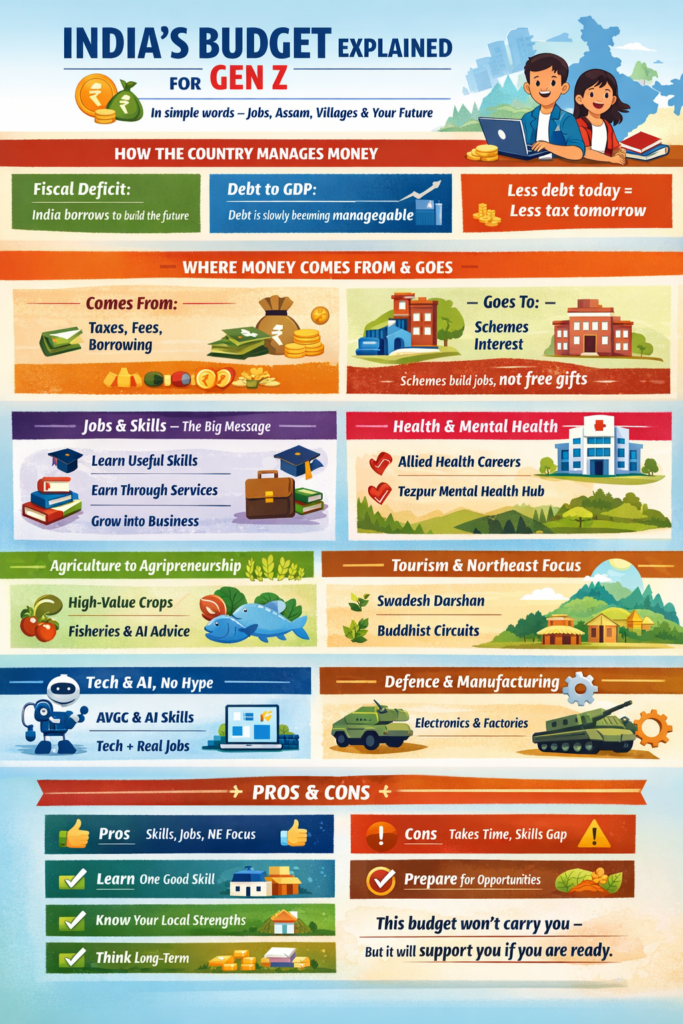
The nation’s “money report card”: deficit, debt, GDP, and why it matters
Imagine India is a very big family.
Every year, the family makes a plan:
- How much money will we earn this year?
- How much money will we spend this year?
- If spending is more than earning, how much money will we borrow?
That yearly plan is the Budget.
Now let’s decode the 3 big words you asked about, like explaining to a Class 8 student.
1. What is the Fiscal Deficit? Why is “4.3% of GDP” important?
Fiscal deficit = (Total spending) − (Total income) for the government in one year.
If it’s positive, it means:
“We don’t have enough income, so we will borrow the remaining money.”
Example:
Your family earns ₹10,000 a month but spends ₹11,000.
So every month you borrow ₹1,000.
That ₹1,000 is your “deficit”.
Now, the government doesn’t just say “₹X deficit”. It also says it as a percentage of GDP.
What is GDP?
GDP is like “India’s total yearly earning power” (not exactly salary, but total value produced).
So 4.3% of GDP means:
“For every ₹100 that India produces, the government needs to borrow about ₹4.30 to run the country this year.”
Why should you care?
Because deficits are not always bad, but:
- Small/controlled deficit = the country is borrowing carefully.
- Big/uncontrolled deficit = future you may pay for it through higher taxes, inflation, or fewer services.
Think of it like this:
Borrowing is okay when it builds a house (roads, hospitals, trains).
Borrowing is risky when it’s only for daily expenses and keeps growing.
2. What is Debt-to-GDP? Why is “declining” good?
Debt is the total money the government already owes (past borrowing).
Debt-to-GDP compares:
- “How big is our total loan?”
vs - “How strong is our earning power as a country?”
Story example:
If you owe ₹50,000 and you earn ₹10,000/month, your debt is heavy.
If you owe ₹50,000 and you earn ₹50,000/month, your debt is manageable.
So when Debt-to-GDP declines, it usually means:
“Our ability to handle loans is improving.”
Why it matters to you (Gen Z)
If debt keeps rising too fast:
- More money goes to interest payments
- Less money remains for education, jobs, health, and roads
When debt becomes manageable:
- The government has more freedom to spend on development
- less pressure for future tax hikes
3. Why did I say: “discipline so future interest burden doesn’t explode”?
Because borrowing has a hidden cost: interest.
Interest payment is like:
“Money you pay just because you borrowed money earlier.”
It doesn’t directly build a new road or a new college. It’s like paying EMI.
Example:
If your family takes many loans, one day a large part of the income goes into EMIs.
Then you have less money left for food, education, and repairs.
Same with the country:
- Higher debt → higher interest bills
- Higher interest bills → less “free money” for public projects
So when the budget tries to reduce deficit and debt ratios, it’s basically saying:
“We want development, but we also don’t want the country stuck paying EMIs forever.”
4. Budget size: “Where money comes from” and “where it goes”
Where government money comes from
Think of it as 3 buckets:
- Taxes (highest regular income)
- GST, income tax, corporate tax, customs, etc.
- Non-tax income
- dividends, fees, telecom spectrum, etc. (not always huge)
- Borrowing (Debt receipts)
- This is money taken as loans to cover the deficit
Where government money goes
Also, 3 big buckets:
- Schemes
- programs for citizens: roads, rural jobs, health, education support, agriculture support, etc.
- Interest
- paying interest on past loans
- Transfers to states
- Centre sends funds to states so they can run schools, hospitals, roads, etc.
5. Is “a large chunk going to schemes” good or bad?
It depends on what the schemes are doing.
Schemes can be of two types:
Good scheme spending (investment type):
- building hospitals, roads, skill centres
- improving tourism infrastructure
- improving farming productivity
These help the economy grow and create jobs.
Risky scheme spending (consumption type):
- spending that doesn’t improve future capacity
- leakage/corruption/inefficiency
- Too many schemes with weak delivery
So “high scheme spending” isn’t automatically good or bad.
The real question is:
“Are schemes giving results, or just spending money?”
What can be done to make scheme spending better?
In simple words:
- spend more on projects that create jobs and productivity
- Reduce waste/leakage using better tracking and delivery
- Stop repeating schemes that don’t work
Takeaway
This budget is trying to do a balancing act:
develop the country (spend on schemes and capex) while keeping borrowing under control so future India isn’t crushed by interest.
Jobs, Skills, Education → Employment → Enterprise
Imagine three steps of a ladder:
- Education – what you learn
- Employment – how you earn
- Enterprise – how you create work for yourself and others
The budget is basically saying:
“If these three steps are weak or broken, young people will struggle. So we must strengthen all three together.”
Let’s decode how.
1. Why is the Services Sector getting so much attention?
First, what is the services sector?
Anything where you sell skills or time, not physical products.
Examples:
- Teaching, nursing, and medical technicians
- Tourism, hotels, guides, travel planning
- IT, design, video editing, animation
- Accounting, marketing, content, consulting
India today:
- Has more young people than many countries
- Cannot give everyone factory jobs
- Can export services to the world (online + offline)
So the government is thinking:
“If millions of young Indians learn useful skills, they can earn from anywhere even small towns and villages.”
That’s why services = jobs + exports.
2. “Skills that sell as services” — what does this really mean?
Let’s use a village example.
Example 1: Without skills
A young person finishes school, but:
- no special skill
- depends only on government jobs or daily labour
Result:
- few opportunities
- heavy competition
- slow income growth
Example 2: With sellable skills
Another young person learns:
- nursing support/lab tech
- video editing/animation
- digital marketing
- hospitality operations
- AI tools + local language knowledge
Result:
- can work in hospitals, hotels, startups
- can freelance online
- can start a small services business
So when the budget talks about:
Education → Employment → Enterprise
It means:
- learn something practical
- earn through that skill
- Later, build a business around it
3. Why entrepreneurship alone is NOT enough
Many people say:
“Be an entrepreneur, start a business.”
But here’s the reality:
- Not everyone can start a company at 18
- Businesses fail without skills
- Capital + experience + network matter
So the budget’s thinking is more realistic:
“First create skilled workers.
Then some of them will naturally become entrepreneurs.”
That’s why skills come before startups.
4. PM Internship Scheme — why it matters for Gen Z
Think of internships like training wheels on a bicycle.
Many students face this problem:
- degree done
- no real work experience
- Companies say: “You need experience”
The PM Internship Scheme tries to solve this gap.
Why this matters:
- You learn how real workplaces function
- You understand whether a career suits you
- You build confidence and contacts
- You become “job-ready”, not just “degree-ready.”
For Gen Z:
Internships = bridge between classroom and real life
5. Healthcare workforce — why the Government is investing here
Big reality:
India needs far more healthcare workers than just doctors.
Doctors are important, but:
- One doctor needs many trained helpers
- hospitals need technicians, therapists, and counsellors
That’s why the budget talks about:
- Allied Health Professionals (AHPs)
- training 100,000+ people in roles like:
- lab technicians
- radiology assistants
- OT technicians
- mental health support roles
Why this is powerful for Gen Z:
- shorter training than MBBS
- quicker entry into stable jobs
- Demand exists in cities AND towns
Career ladder example:
AHP → Senior Tech → Supervisor → Trainer → Clinic owner
This is how employment slowly becomes enterprise.
6. Education: not just colleges, but access + inclusion
EMRS (Eklavya Model Residential Schools)
These schools:
- Focus on tribal and remote regions
- give quality education + residence
Why this matters for Northeast & villages:
- Students don’t have to migrate early
- better foundation → better career choices later
This isn’t flashy, but it’s long-term nation-building.
7. Mental health focus (Tezpur, NIMHANS-2) — why it’s big
Mental health is often ignored, especially outside metros.
By upgrading institutions like Tezpur:
- treatment becomes closer to home
- awareness increases
- new careers open:
- psychologists
- counselors
- psychiatric social workers
Pros:
- reduces stigma
- supports youth mental health
- creates local health jobs
Cons/caution:
- Institutions alone won’t help unless:
- trained professionals are available
- People are willing to seek help
Still, this is a strong positive signal.
8. Big picture for Gen Z
If you are Gen Z, the budget is quietly telling you:
- Don’t rely only on government jobs
- Build skills that solve real problems
- Services are as valuable as factories
- Healthcare, education, tourism, tech skills = future jobs
- Start as a learner → become a worker → grow into a creator
In simple words:
Learn something useful, then use it to earn, then grow it into something bigger.
Tourism, Hospitality & the Northeast
Imagine India is a huge storybook.
Every state has a different chapter: mountains, temples, rivers, cultures, food, and festivals.
Tourism is simply:
Inviting the world to read and experience those chapters and earn from it.
Now let’s break this down slowly.
1. Why is the government spending on tourism at all?
Tourism is special because:
- It creates jobs quickly
- It doesn’t need heavy factories
- It spreads money to local people, not just big companies
One tourist coming to a place:
- pays the driver
- eats at local food stalls
- stays in a hotel or homestay
- buys local crafts
- hires guides
That single tourist supports many families.
So when the budget supports tourism, it’s saying:
“Let people earn where they live, instead of migrating.”
2. What is Swadesh Darshan (tourist circuits)?
Think of a circuit like a “connected travel route”.
Instead of one spot, the government develops:
- roads
- toilets
- signage
- lighting
- facilities
across multiple nearby destinations.
Example:
Not just one temple, but:
- temple
- nearby village
- nearby viewpoint
- nearby cultural site
This makes tourists stay longer → spend more → locals earn more.
3. Why Buddhist Circuits Matter So Much for the Northeast
The budget specifically talks about developing Buddhist Circuits in:
- Arunachal Pradesh
- Sikkim
- Assam
- Manipur
- Mizoram
- Tripura
Why Buddhism?
Because:
- Buddhists across Asia (Japan, Korea, Thailand, Sri Lanka, etc.) travel for pilgrimage
- They are respectful tourists
- They stay longer and spend steadily
Why Northeast?
The Northeast has:
- authentic Buddhist heritage
- natural beauty
- less overcrowding
The budget’s thinking is:
“Turn culture + spirituality + nature into sustainable income.”
4. How does this help Assam and nearby states?
Let’s use a realistic Assam example.
A Buddhist circuit is developed:
- better roads
- signboards
- basic facilities
- marketing abroad
Direct benefits:
- local drivers get trips
- Small hotels get bookings
- local guides get work
- Food stalls get customers
Indirect benefits:
- youth learn foreign languages
- local crafts get value
- digital marketing & content jobs grow
5. “But not everyone can open a homestay.”
Very important point.
Tourism is not only about owning property.
Here are realistic Gen Z roles in tourism:
Service roles
- Tour coordinator
- Guide (culture, nature, language-based)
- Travel planner (online/offline)
- Hospitality manager
Skill-based roles
- Photographer/videographer
- Social media manager for hotels
- Content writer for travel companies
- Booking & operations executive
Support roles
- Transport coordination
- Event & festival management
- Local experience design (food walks, cultural shows)
Digital roles (big future)
- Managing listings (Airbnb, Booking, MakeMyTrip)
- Running tourism Instagram pages
- Editing reels & videos for travel brands
You don’t need land — you need skills + local knowledge.
6. Why is it good for villages and small towns
Factories:
- concentrate jobs in one place
Tourism:
- spreads income across many villages
For a village youth:
- You can stay close to home
- earn from local culture
- preserve traditions instead of abandoning them
That’s why tourism is often called:
“Low-capital, high-employment sector.”
7. Pros and cons of the tourism push
Pros
- fast job creation
- supports women & youth
- promotes local identity
- earns foreign exchange
Cons/risks
- Over-tourism can damage nature
- Culture can become a “showpiece.”
- Income can be seasonal
That’s why the budget focuses on circuits + planning, not random tourism.
8. Gen Z mindset shift
Earlier thinking:
“Tourism jobs are low-status.”
New reality:
Tourism + digital skills + management = serious career.
A Gen Z student can think:
- “I know my region”
- “I can learn skills”
- “I can earn globally from local knowledge”
That is the hidden opportunity.
Takeaway
The budget is saying:
“Your culture, land, and stories are not backward — they are economic assets if developed wisely.”
Content Creation, AVGC, AI, IT, and New-Age Tech
Let’s start with a big misunderstanding and clear it first.
1. Does “content creation” mean everyone should make reels and dance on Instagram?
No. Absolutely not.
When the budget talks about AVGC (Animation, Visual Effects, Gaming, Comics) and digital skills, it is NOT saying:
“Everyone become an influencer.”
The government is talking about the digital creative industry, not social-media fame.
Think of it like this:
Instagram reels = one small leaf
AVGC industry = the entire tree
2. What is AVGC in very simple words?
AVGC means:
- Animation – cartoons, explainer videos, films
- VFX – special effects in movies, ads, OTT
- Gaming – mobile games, PC games, game design
- Comics – graphic stories, digital comics, IP creation
These are real industries where:
- studios hire people
- Skills matter more than followers
- Work is project-based and global
3. Why is the government even interested in this?
Because AVGC has 4 big advantages for India:
- Youth-heavy industry
Young people learn faster and adapt easily. - Skill-based, not land-based
You don’t need factories or land. - Export potential
Indian animators already work for Hollywood, Japan, and Korea. - Works from anywhere
A person in Assam can work for a studio in Mumbai or abroad.
So the government sees AVGC as:
“Jobs + exports + digital India”
4. So what should Gen Z actually focus on?
What NOT to blindly chase
- Viral fame without skill
- Depending only on social media algorithms
- Thinking “views = career”
What TO focus on instead
Foundational digital skills, such as:
- animation basics
- video editing
- motion graphics
- sound design
- storytelling
- game design logic
These skills:
- work behind the scenes
- are always in demand
- don’t disappear if an app dies
5. AI and IT — Is AI going to steal all jobs?
Short answer: AI will change jobs, not end them.
Think of AI like a power tool.
Example:
- The calculator didn’t kill maths
- Tractors didn’t kill farming
- Computers didn’t kill offices
They changed how work is done.
6. How the budget is positioning AI
The budget does NOT treat AI as:
“Only coding or IT jobs”
Instead, AI is shown as something that helps:
- farmers
- healthcare workers
- educators
- service professionals
That’s why AI is linked to:
- agriculture advisories
- healthcare systems
- skill development
- local language tools
7. AI in agriculture
Imagine a farmer asking:
- “When should I sow?”
- “Will it rain?”
- “Which pest is attacking my crop?”
Earlier:
- depended on guesswork or local advice
With AI tools (like Bharat-VISTAAR):
- advice in the local language
- based on data
- faster decisions
Why this matters for Gen Z
You don’t need to be a software engineer to work in AI-enabled agriculture.
Roles can be:
- field coordinators
- data collectors
- agri-tech support staff
- local language trainers
- agri-service entrepreneurs
8. IT sector — what’s changing?
Earlier IT jobs:
- repetitive coding
- process work
Now IT jobs:
- problem solving
- system design
- AI-assisted work
- domain knowledge (health, agri, finance)
So Gen Z should think:
“Tech + another domain”
Examples:
- Health + tech = healthtech
- Farming + tech = agritech
- Finance + tech = fintech
- Tourism + tech = traveltech
9. How does this help the nation?
When India exports:
- software
- animation
- digital services
- AI-enabled solutions
It earns foreign money without shipping goods.
That strengthens:
- currency
- economy
- job market
And it reduces dependency on factories alone.
10. Clear guidance for Gen Z
Ask yourself 3 questions:
- Do I like creating or solving problems?
- Can my skill work online or digitally?
- Can it help other industries (health, agri, tourism)?
If yes → you’re aligned with where the budget is pointing.
Takeaway
The budget is saying:
“Don’t chase internet fame. Build digital skills that quietly power the economy.”
Defence, Manufacturing and “Make in India”
Let’s clear one big myth first.
1. Defence spending ≠ only on soldiers and war
When people hear the defence budget, they think:
guns, tanks, borders, army
But in reality, defence today is also about:
- factories
- electronics
- software
- research
- logistics
- maintenance
So defence spending creates civilian jobs, not just military ones.
2. Why does a country spend on defence at all?
Think of defence like locks on your house.
You don’t install locks because you want a fight.
You install locks so you can:
- live peacefully
- focus on work, education, growth
For a country:
- strong defence = stability
- stability = investor confidence
- confidence = jobs and growth
That’s why defence is treated as foundational, not optional.
3. What is changing in defence thinking?
Earlier:
- India bought most of its defence equipment from abroad
Problem:
- expensive
- dependent on other countries
- limited local jobs
Now the thinking is:
“Design, build, and maintain more things inside India.”
That’s where manufacturing ecosystems come in.
4. What is a “manufacturing ecosystem”?
Not one big factory — but many connected units.
Example:
- One company makes chips
- One makes cables
- One makes metal parts
- One writes software
- One does maintenance
Together, they support one defence system.
This creates:
- thousands of jobs
- skill-based work
- long-term demand
5. Where does Gen Z fit into defence manufacturing?
You do not need to be in uniform.
Technical roles
- mechanical engineers
- electronics technicians
- drone operators
- quality inspectors
Digital roles
- software testing
- data analysis
- simulation & modelling
- cybersecurity
Support roles
- logistics planning
- documentation
- supply chain coordination
- vendor management
Research & innovation
- materials science
- AI-based systems
- energy efficiency
6. Why manufacturing matters for the nation
Manufacturing:
- creates stable jobs
- builds long-term skills
- reduces imports
- keeps money inside the country
For a young country like India:
Manufacturing = employment engine
That’s why defence manufacturing is treated as a strategic industry, not just spending.
7. Pros and cons of defence-led manufacturing
Pros
- high-skill jobs
- strong R&D culture
- global export potential
- long-term projects (job security)
Cons/risks
- Projects can be slow
- requires high discipline and quality
- less flexibility than startups
So it’s good for:
- people who like structure
- long-term career builders
- technical minds
8. What should Gen Z realistically think?
Instead of asking:
“Should I join defence?”
Ask:
“What skill can I offer to defence-linked industries?”
Examples:
- robotics
- electronics repair
- coding + systems
- advanced manufacturing
Takeaway
The budget is telling Gen Z:
“Defence is not just about fighting — it’s about building capability, skills, and industries that protect growth.”
Agriculture, Rural Livelihoods and Agripreneurship
First, a truth we must accept:
Most of India still lives in villages and small towns.
So if villages don’t progress, India cannot progress.
That’s why the budget keeps coming back to:
- farming
- animal husbandry
- fisheries
- value chains
- rural entrepreneurship
Not because agriculture is “old”, but because it’s the base of daily life.
1. The big idea: “Stop selling only raw stuff”
Most farmers suffer because they sell raw products:
- paddy
- vegetables
- fish
- milk
Raw products:
- spoil quickly
- Give low profit
- depend on middlemen
- Price changes a lot
So the budget’s hidden message is:
“Make villages earn more by doing value addition and organised selling.”
That is why it mentions:
- value chains
- processing
- storage
- entrepreneurship
- startups
- women groups
2. Fisheries – why it’s highlighted and why it matters for Assam
The speech talks about:
- utilising reservoirs
- strengthening value chains
- supporting startups
- involving women self-help groups budget_speech
Why fisheries are a smart focus
Fish is:
- high-demand food
- faster income cycle than many crops
- suitable for many Northeast belts (water availability)
What “value chain” mean here
Not just “catch fish and sell.”
A value chain is:
- fish seed + feed + pond management
→ harvesting
→ cold storage
→ transport
→ clean packaging
→ market link
When this chain is strong, the farmer earns more.
Gen Z opportunity
A Gen Z person can build services around fisheries:
- fish feed and supplies business
- pond testing and water quality service
- cold chain logistics coordination
- packaging and branding for local fish sellers
That’s agripreneurship:
“Helping agriculture run like a business.”
3. Animal Husbandry — why it’s mentioned
Speech mentions:
- entrepreneurship in animal husbandry
- credit-linked support
- Integrated Value Chains Budget Speech
Why animal husbandry is important
Because livestock gives:
- daily income (milk/eggs)
- income security when crops fail
- nutrition + livelihood together
What “credit-linked support” means
It means:
“Loans and support will be tied to productive activity.”
So not random money — but money given where:
- You can start/expand a real business
Gen Z angle
Examples of agribusiness ideas:
- dairy collection and chilling unit coordination (small scale)
- veterinary service + medicine distribution (business)
- poultry supply chain management
Even if you’re not rich, you can start small and scalable.
4. High-value crops — why the Northeast gets direct mention
Speech mentions:
- high-value crops
- agar trees in the North East budget_speech
Why this is a big Northeast signal
Agarwood (agar tree) is not like ordinary crops:
- high value
- connected to the fragrance/oil industry
- export relevance
So when this is named, it means:
“The government recognises Northeast’s unique agricultural strengths.”
What Gen Z should understand here
Northeast has products that are:
- niche
- premium
- exportable
If handled properly, it becomes:
- high-income agriculture
- branded exports
- rural enterprise
5. “Mission for High-Yielding Seeds” — what it means for farmers
The speech mentions:
- a mission for high-yielding seeds budget_speech
Simple meaning:
“Better seeds = more output from same land.”
Why it matters:
- land is limited
- The population is big
So productivity must rise without destroying soil.
Gen Z angle
This creates scope for:
- agri-input distribution business
- seed awareness + advisory work
- farm productivity consulting (small scale)
6. Bharat-VISTAAR (AI in agriculture) — why it matters for rural livelihoods
Speech says:
- Bharat-VISTAAR is a multilingual AI tool
- integrates AgriStack + ICAR practices
- provides customised advisories and reduces risk budget_speech
Imagine a “smart teacher” for farmers on the phone:
- tells what to grow
- warns about pests
- suggests safe practices
- speaks in your language
This reduces:
- wrong decisions
- losses
- waste of money on the wrong fertiliser/pesticides
How Gen Z benefits
Village Gen Z can become:
- “AI agriculture helper” in the community
- local advisor who helps farmers use tools
- a micro-entrepreneur charging small fees for advisory support
- a bridge between tech and farmers
This is a new type of rural career.
7. SHE-Marts — why women’s entrepreneurship is included
Speech mentions:
- SHE-Marts to promote women entrepreneurs and self-help groups
- marketing/packaging help
- scaling up outlets budget_speech
Why this matters
Many women in villages produce:
- pickles
- weaving
- handmade items
- food products
But they struggle with:
- branding
- packaging
- access to markets
SHE-Marts is basically a way of saying:
“Women should not stay stuck in local sales only.”
Gen Z angle
A Gen Z person can support women SHGs by building:
- branding + packaging services
- digital selling support
- logistics arrangement
- photography + listing work
So entrepreneurship isn’t only “startup in Bangalore.”
It can be:
“Building a business that helps local producers sell better.”
8. “So how does a village youth become an agripreneur?”
Let’s build a simple ladder.
Step 1 — Pick one local strength
Example:
- fish
- dairy
- high-value crops
- crafts
Step 2 — Identify one problem farmers face
Common problems:
- storage
- transport
- pricing
- packaging
- advice
- middlemen
Step 3 — Build a small service around that problem
Examples:
- Organise transport once a week
- Create a small cold storage tie-up
- build a WhatsApp ordering group
- offer advisory + farm record keeping
Step 4 — Scale slowly
- from one village → 5 villages
- from 10 farmers → 100 farmers
This is how budgets turn into real livelihoods.
9. Pros vs Cons of this agriculture push (important to know)
Pros
- improves rural income
- creates local enterprise opportunities
- reduces migration pressure
- adds stability to the food supply
Cons/risks
- If implementation is weak, benefits don’t reach farmers
- Value chains need infrastructure (storage/roads)
- AI tools won’t help if connectivity/digital literacy is poor
So the idea is strong — but success depends on execution.
Takeaway
The budget is telling rural India and Gen Z:
“Villages should not remain only producers of raw goods — villages should become organised businesses.”
Northeast and Assam Focus (Purvodaya, Value, Strategy, Reality)
Let’s start with why the Northeast matters nationally, not emotionally but economically.
1. What does “Purvodaya” actually mean?
Purvodaya = Rise of the East
In simple words, the government is saying:
“India’s future growth cannot come only from big western and southern cities. The eastern and northeastern regions must grow too.”
Why?
Because:
- Land and cities in the West/South are crowded
- Costs are rising there
- Northeast has space, nature, culture, borders, and youth
So Purvodaya is not charity.
It is a strategic development.
2. Why the Northeast is economically special
The Northeast has four rare strengths that many regions don’t.
Geography (Gateway strength)
The Northeast connects India to:
- Southeast Asia
- East Asia
That means:
- trade
- tourism
- logistics
- strategic importance
Culture & spirituality
The Northeast has:
- Buddhist heritage
- tribal traditions
- unique languages
- ecological balance
These are economic assets if developed carefully.
Agriculture diversity
Unlike monoculture belts:
- high-value crops
- niche products (agar, spices, herbs)
- fisheries and forest-based livelihoods
Youth population
Young people + lower cost of living = high potential workforce
3. Why Buddhist Circuits are a big Northeast signal
This is not random tourism.
The government is thinking:
“Spiritual tourism brings stable, respectful, long-term visitors.”
Buddhist tourists:
- Come for purpose (not party tourism)
- stay longer
- spend on local services
- respect culture and environment
Why does this matter for Assam and its neighbours
When circuits are created:
- Multiple states benefit together
- roads, signage, and facilities improve
- global visibility increases
This also improves:
- International perception of the Northeast
- soft power
- foreign tourist inflow
4. Mental health institute at Tezpur — why it’s strategically important
This is very underrated, but very powerful.
What it means:
- Tezpur becomes a regional mental health hub
- Not everything is concentrated in metros
- Northeast gets specialised healthcare capacity
Benefits:
- local treatment access
- Reduced migration for healthcare
- creation of skilled jobs:
- counselors
- psychologists
- psychiatric nurses
- social workers
Gen Z implication:
Healthcare careers don’t require leaving the region anymore.
5. High-value agriculture (Agar, niche crops) — why it’s mentioned
The budget specifically names high-value crops in the Northeast.
That means:
“This region shouldn’t copy Punjab or Haryana farming.
It should build on what it already does best.”
High-value crops:
- need less land
- Give more income
- suit forest and hilly ecosystems
Why this is smart:
- protects ecology
- increases income
- builds export identity
This is smart agriculture, not mass agriculture.
6. How Purvodaya actually helps Gen Z
Let’s connect all threads.
If you’re interested in:
- Tourism → Buddhist circuits + Swadesh Darshan
- Healthcare → Tezpur Institute + allied health roles
- Agriculture → high-value crops + AI advisory
- Entrepreneurship → value chains + SHGs + services
- Content/Media → culture, tourism, documentation
The Northeast becomes a workplace, not just a birthplace.
7. What the government is really thinking
The budget’s silent message is:
“We don’t want the Northeast to be dependent only on subsidies.
We want it to generate its own economic momentum.”
That’s why:
- circuits, not isolated spots
- value chains, not raw selling
- institutions, not only schemes
8. Pros and cons of this Northeast focus
Pros
- reduces regional imbalance
- creates local jobs
- preserves culture
- improves strategic presence
Cons/risks
- slow execution
- connectivity challenges
- requires strong state-level implementation
- youth must skill up, not just wait
So opportunity exists, but it is not automatic.
9. What Gen Z in Assam should not misunderstand
This does NOT mean:
- Free money will come
- Jobs will be handed out
- Migration will stop overnight
It DOES mean:
- Direction is changing
- Region is becoming relevant
- Those who prepare early will benefit most
Takeaway
The budget is quietly saying:
“The Northeast is no longer the edge of India’s map — it is becoming part of India’s growth strategy.”
Foreign Investment, NRIs and “Money Coming into India”
Let’s start with a very basic question.
1. What is foreign investment in simple words?
Foreign investment means:
Money coming into India from outside the country
to build businesses, buy shares, start factories, or fund startups.
Think of it like this:
If a relative is living abroad:
- puts money into your family’s shop
- helps you buy better tools
- expects the shop to grow
That is investment, not charity.
2. Why does India want foreign investment at all?
Because foreign money helps in three big ways:
- Creates jobs
When money comes in, businesses expand → people are hired. - Brings new technology & skills
Foreign companies bring:- better systems
- better quality standards
- global exposure
- Reduces pressure on government borrowing
If private money invests, the government doesn’t need to borrow as much.
So foreign investment = growth without extra debt.
3. What did the budget say about NRIs/people living abroad?
The budget mentions:
- People of Indian origin living outside India
- Easier rules for them to invest in Indian companies (listed equity)
- Reviewing rules to make foreign investment smoother and more modern
Simple meaning:
“We want Indians abroad to feel confident putting money back into India.”
This is important because:
- NRIs trust India
- NRIs understand Indian culture + global markets
- Their money is more patient (long-term)
4. Why is this good for the country?
When NRIs invest:
- Money stays longer
- businesses become stronger
- startups get funding
- stock markets deepen
This helps:
- economy stability
- job creation
- innovation
It also improves India’s global image:
“People who left still believe in India’s future.”
5. But will this only help big cities and big companies?
Not necessarily, and this is where Gen Z comes in.
Foreign investors don’t invest blindly.
They invest where there is:
- clarity
- opportunity
- skilled people
- local partners
That means:
Regions that prepare themselves can attract investment.
6. How can foreign investment reach the Northeast?
Foreign investors look for:
- unique opportunities
- low competition
- authentic value
The Northeast offers:
- tourism (eco, spiritual, cultural)
- high-value agriculture
- niche products
- strategic location near Southeast Asia
But investment won’t come just because it’s mentioned in a budget.
It comes when:
- projects are well-prepared
- people can execute
- Systems are transparent
7. What role can Gen Z realistically play here?
You don’t need crores of rupees.
Gen Z can become:
- local execution partners
- project managers
- on-ground coordinators
- startup founders with local insight
Example:
An NRI wants to invest in:
- eco-tourism lodge
- food processing
- agri-export
- digital services
They need:
- someone local
- someone skilled
- someone trustworthy
That’s where prepared Gen Z fits in.
8. Important warning
Foreign investment is not free money.
It does NOT mean:
- instant success
- guaranteed income
- no responsibility
It DOES mean:
- accountability
- quality standards
- discipline
- long-term thinking
If projects fail:
- investors leave
- The region gets a bad reputation
So maturity matters.
9. How Gen Z should prepare for this
- Learn one solid skill
- Understand local problems
- Build a small proof of work
- Learn basic finance & compliance
- Be reliable and transparent
Foreign investors invest in people first, ideas second.
10. Pros & cons of foreign investment
Pros
- job creation
- technology transfer
- global exposure
- less pressure on government debt
Cons/risks
- If poorly regulated, profits leave the country
- local businesses can be crushed
- dependency risk
That’s why a balanced policy is needed.
Takeaway
The budget is telling India and Gen Z:
“The world is ready to invest in India — but only those who are prepared will benefit.”
Taxes, Daily Life Impact, What Improved, What Didn’t, and a Final Gen-Z Checklist
This is the last big lens. Everything we discussed before (jobs, tourism, AI, agriculture) only works if daily life economics make sense.
Let’s break it down slowly.
1. Taxes — what is the government really trying to do?
First, a basic truth:
Taxes are not punishment.
Taxes are how a country runs itself.
You pay taxes so the government can:
- build roads
- run schools and hospitals
- defend borders
- support the poor
- Invest in the future
What the budget signals (without going into technical slabs)
From the documents you shared, the intent is:
- Keep tax collections strong
- Avoid sudden shocks
- Balance the taxpayer burden with development needs
This budget is not about radical tax changes.
It is more about stability.
That tells us something important:
“The government wants predictable revenue, not experiments.”
2. How does this affect a normal citizen’s daily life?
Let’s look at it from daily activities.
Roads, transport, connectivity
- More capital expenditure (big projects)
- Better logistics
- Easier movement of goods and people
Impact:
- lower travel time
- lower transport cost
- better access to markets
Health and education
- Mental health institutions
- Allied health workforce
- Schools in remote areas
Impact:
- services closer to home
- less migration pressure
- better quality of life
Food and essentials
- Focus on agricultural productivity
- AI advisories
- value chains
Impact:
- more stable supply
- less price shock
- better farmer income → rural demand
3. Why “interest payment” matters to taxpayers
Remember, we talked about interest?
Interest payment is like:
Paying EMI for past loans.
If interest becomes too big:
- The government has less money for welfare
- Taxes may rise in future
- Inflation pressure increases
This budget tries to:
- slow down debt growth
- keep interest manageable
That is good for future taxpayers, especially Gen Z.
4. What improved in the last year?
From the budget documents:
Positive trends
- Fiscal deficit ratio slightly improved
- Debt-to-GDP ratio declining
- Continued capital expenditure
- Focus on productivity sectors
Meaning:
The economy is not overheating, nor collapsing.
It’s moving carefully forward.
This matters because:
A stable economy gives:
- job confidence
- investment confidence
- predictable future
5. What did NOT dramatically improve?
- Income inequality is still a challenge
- Execution speed varies across states
- Youth expectations are rising faster than job creation
- Skill mismatch still exists
So the budget is directionally right, but:
Outcomes depend heavily on execution.
6. What should Gen Z NOT misunderstand about this budget
This budget does NOT guarantee:
- instant jobs
- free money
- easy success
- overnight Northeast transformation
It does NOT mean:
- Everyone should become a creator
- Everyone should start a startup
- Everyone should go into tech
7. What the budget IS quietly telling Gen Z
Let me summarise the hidden messages in very simple words:
- India will grow through skills, not shortcuts
- Services, health, tech, tourism, and agriculture will drive jobs
- Regions like the Northeast are now economically relevant
- Future taxes depend on how responsibly we grow today
- Prepared youth will benefit more than waiting youth
8. A simple Gen-Z decision guide
Ask yourself these 5 questions:
Do I want stability or risk?
- Stability → health, allied health, education, structured services
- Risk → entrepreneurship, content, startups
Do I like people, systems, or technology?
- People → tourism, healthcare, education
- Systems → logistics, operations, administration
- Technology → AI, IT, digital services
Can my skill work locally AND globally?
If yes → very strong future alignment
Does my plan solve a real problem?
If yes → budget direction supports you
Am I upgrading my skills every year?
If no → budget benefits may pass you by
9. One big life lesson from this budget
Imagine two students:
- One waits for opportunities
- One prepares for opportunities
This budget is creating opportunities, not distributing answers.
This budget is not flashy, not emotional, and not revolutionary. It is structural, cautious, and future-oriented.
It tries to balance development with discipline, growth with responsibility, and opportunity with stability.For Gen Z, especially in regions like Assam and the Northeast, the message is clear:
Learn useful skills, understand your local strengths, think long-term, and don’t wait for the system to carry you.