
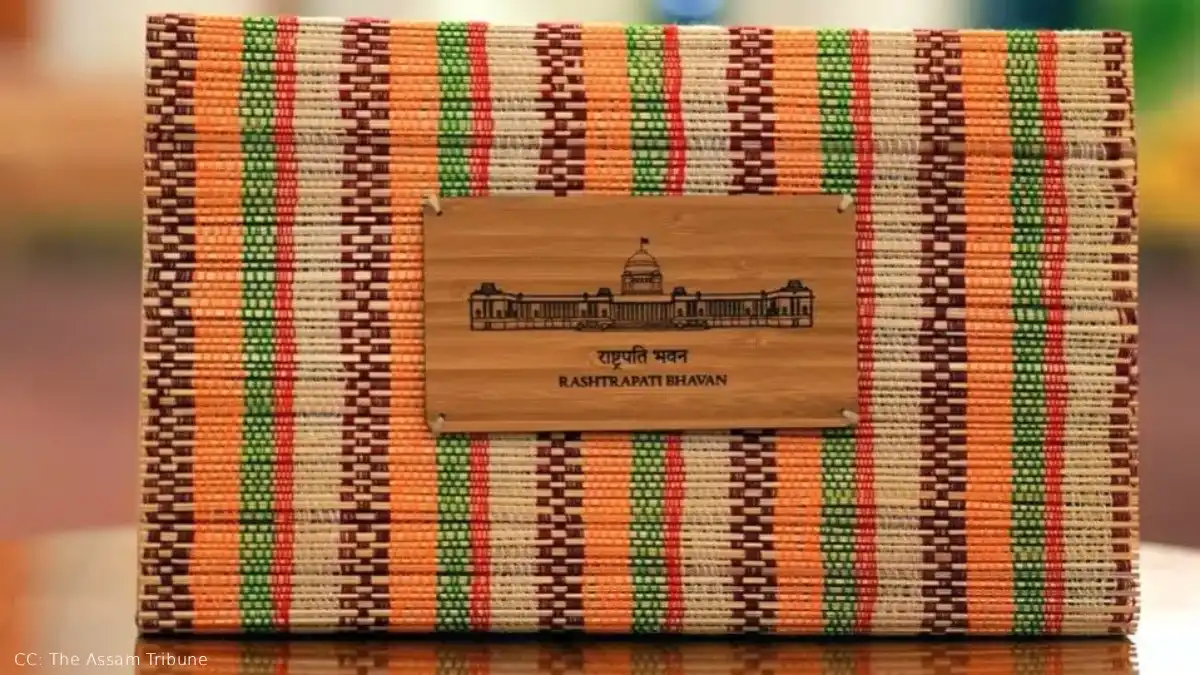
The official invitation for this year’s Republic Day At Home Reception, sent by the President of India, has brought Assam’s traditional art forms closely associated with Guwahati’s cultural ecosystem into the national spotlight. The invite celebrates the living craft traditions of Northeast India, with Assamese visual and musical heritage featured prominently.
The reception will be hosted at Rashtrapati Bhavan, but the design language of the invitation draws directly from art forms preserved, practiced, and promoted across Assam, with Guwahati serving as the region’s primary cultural and artistic hub.
The Republic Day At Home Reception invitation highlights Assamese manuscript-style painting and the traditional Gogona instrument, placing Assam and Guwahati’s cultural heritage at the centre of a national ceremonial event. The design celebrates Northeast India’s living craft traditions through visual art, textiles, and indigenous materials.
Assamese Manuscript Art Leads the Visual Narrative
At the heart of the invitation is a wall-hanging scroll that unfolds in panels, beginning with an Assamese manuscript-style painting. This art form, historically linked to Vaishnavite traditions and satras, continues to be studied, archived, and revived through institutions and artists based in Guwahati.
Cultural historians note that Guwahati has played a key role in preserving manuscript aesthetics both through academic research and contemporary reinterpretations, making its inclusion in the invitation symbolically significant.
Gogona Represents Assam’s Living Musical Tradition
The invitation also features the Gogona, a traditional bamboo jaw harp integral to Assamese folk music. Often associated with Bihu and rural performance traditions, the Gogona today finds renewed relevance through cultural festivals, workshops, and exhibitions frequently hosted in Guwahati.
Artists and musicians based in the city have been instrumental in reintroducing the Gogona to younger audiences, positioning it as both a musical instrument and a cultural emblem of Assam.
Northeast Crafts Framed Through a Guwahati Lens
Beyond Assam, the scroll showcases craft traditions from across the Northeast, including green bamboo weaving from Meghalaya and Mon Shugu handmade paper from Arunachal Pradesh, shaped into the mithun. Textiles such as Sikkim’s Tara weaving and fibre-based Naga textiles are also featured.
For Guwahati, which functions as the region’s main exhibition, trade, and cultural exchange centre, the invitation reflects how Northeast crafts are often curated, documented, and presented nationally through platforms based in the city.
Cultural Recognition in a National Setting
The Republic Day At Home Reception is among India’s most formal ceremonial events, attended by dignitaries, diplomats, and cultural leaders. The decision to foreground Northeast crafts places Assam and, by extension, Guwahati within India’s core cultural narrative rather than its margins.
Cultural observers say such representation helps shift perception, acknowledging the Northeast not as a peripheral region but as a contributor to India’s living traditions.
Why This Matters for Guwahati
As Assam’s cultural capital, Guwahati has long been the bridge between local craft communities and national institutions. The inclusion of Assamese manuscript art and the Gogona in a presidential invitation reinforces the city’s role in sustaining, interpreting, and projecting Assam’s heritage onto national platforms.
Artists and cultural practitioners see this as validation of years of effort to keep traditional forms relevant in contemporary contexts.
What Comes Next
While the invitation itself is symbolic, cultural bodies in Guwahati are expected to build on this visibility through exhibitions, performances, and documentation initiatives around Republic Day. Observers say sustained engagement, not just ceremonial inclusion, will determine how deeply this recognition translates into long-term support for artisans.
Frequently Asked Questions
Q1. Which Assamese art forms are featured in the Republic Day invitation?
The invitation highlights Assamese manuscript-style painting and the Gogona, a traditional bamboo musical instrument.
Q2. Why is this significant for Guwahati?
Guwahati plays a central role in preserving and promoting Assam’s arts, making the national recognition of these forms closely tied to the city’s cultural ecosystem.