
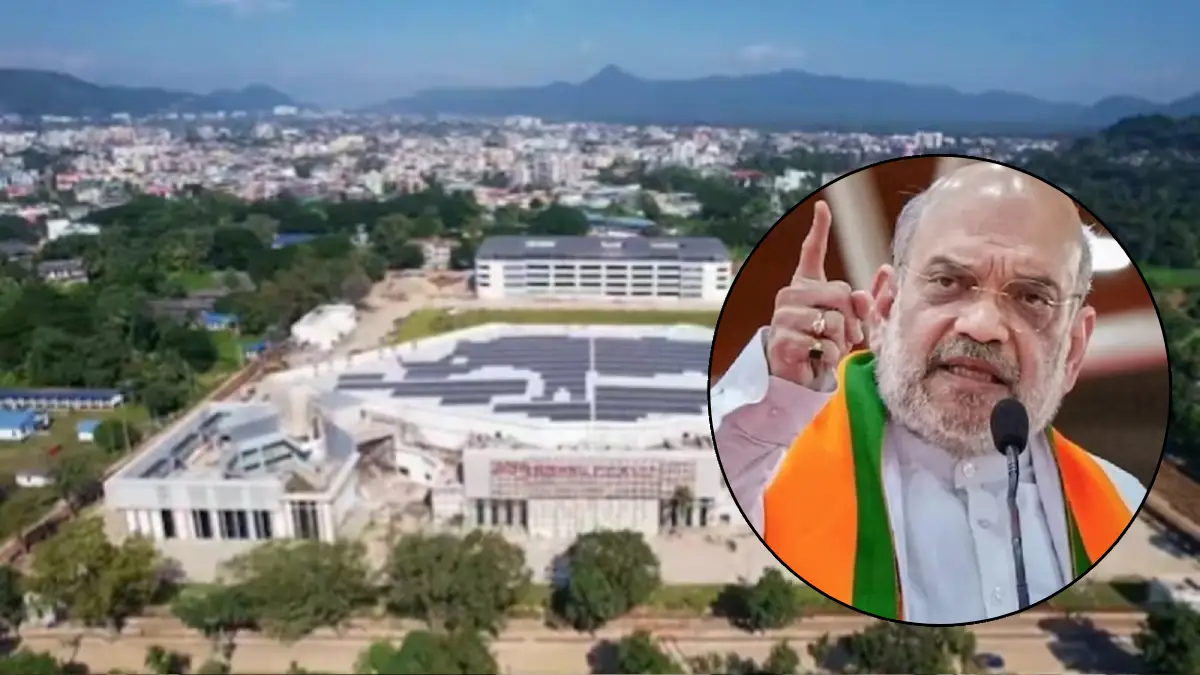
Union Home Minister Amit Shah inaugurated the Jyoti-Bishnu Antarjatik Kala Mandir, Northeast India’s largest auditorium, in Guwahati on Monday, December 29. The inauguration was officially reported on January 1, marking a major addition to Assam’s cultural and public infrastructure.
The newly inaugurated auditorium has been constructed at a cost of ₹291 crore and is designed to host large-scale cultural, artistic, and public events. With a seating capacity of 5,000 people, the facility is among the biggest such venues in the eastern and northeastern regions of India.
Union Home Minister Amit Shah inaugurated the Jyoti-Bishnu Antarjatik Kala Mandir in Guwahati on December 29. Built at a cost of ₹291 crore, it is Northeast India’s largest auditorium with a seating capacity of 5,000. The complex includes modern facilities and runs partly on solar energy.
Key features of the auditorium complex
The auditorium is spread across 45 bighas (approximately 14.85 acres) and has been developed as a multi-purpose cultural and convention hub.
Key facilities include:
- A large-capacity main auditorium with advanced acoustics
- A convention centre for conferences and official events
- VIP suites and dedicated guest facilities
- State-of-the-art audio-visual systems
- Multi-level parking space for up to 450 vehicles
Officials also confirmed that the entire complex has been designed with sustainability in mind.
Focus on green energy and sustainability
One of the notable aspects of the Jyoti-Bishnu Antarjatik Kala Mandir is its emphasis on renewable energy. Solar panels have been installed on the rooftop, enabling the complex to operate partially on green energy. This aligns with broader government efforts to promote sustainable public infrastructure in urban Assam.
Community-focused initiatives during the inauguration
During the inauguration ceremony, Amit Shah also honoured 1,000 beneficiaries of the Congenital Heart Disease (CHD) programme. The gesture highlighted the auditorium’s role not just as a cultural venue, but also as a platform for social and community-oriented initiatives.
Officials indicated that the complex will host cultural programmes, national-level events, exhibitions, and public gatherings, strengthening Guwahati’s position as a regional cultural centre.
What happens next
With the inauguration complete, the auditorium is expected to become fully operational in the coming months. Authorities are likely to announce an official event calendar, booking procedures, and guidelines for public and institutional use.
The project is expected to boost cultural tourism, create event-related employment, and provide Assam with a world-class venue for large-scale national and international programmes.
Frequently Asked Questions
The auditorium can seat up to 5,000 people, making it the largest auditorium in Northeast India.
The auditorium is located in Guwahati, Assam, on a 45-bigha campus with modern facilities and parking infrastructure.