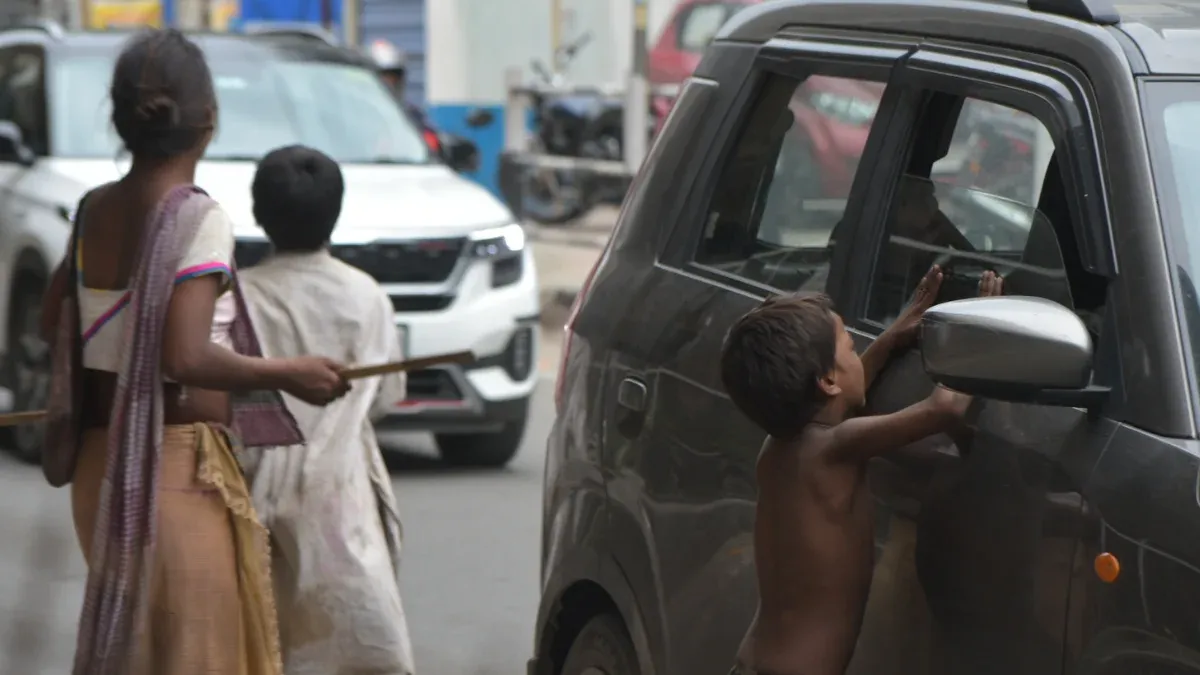
At the Ulubari traffic signal in Guwahati, the red light lasts barely 90 seconds. In that brief pause, individuals move between vehicles, seeking small change from commuters. As the signal turns green, traffic resumes, and the moment disappears until the next stop.
Three years ago, this scene was expected to change. In June 2023, Assam Chief Minister Himanta Biswa Sarma announced that Guwahati would become “beggar-free” by 2025 under the Centre’s SMILE (Support for Marginalised Individuals for Livelihood and Enterprises) scheme.
Despite a 2023 announcement to make Guwahati “beggar-free” by 2025 under the Centre’s SMILE scheme, begging continues in 2026 at traffic signals and public spaces across areas like Ulubari, Paltan Bazar, Pan Bazar, and ABC point, according to on-ground observations.
The 2023 Announcement and SMILE Scheme
In June 2023, the state government linked its vision to the Central government’s SMILE scheme under the Ministry of Social Justice and Empowerment.
The objective of the scheme is to:
- Rescue individuals engaged in begging
- Provide temporary shelter
- Offer skill training and livelihood support
- Facilitate long-term rehabilitation
The broader aim was to ensure that no individual would be forced to beg for survival.
Rescue Drives in 2023 and 2024
Following the announcement, rescue drives were conducted in parts of Guwahati.
Authorities deployed vehicles to pick up groups of individuals from major junctions and public areas. They were shifted to temporary shelters for support and rehabilitation.
For a few weeks after these drives, some traffic signals appeared noticeably emptier.
However, sustained change has remained a challenge.
Current Situation in 2026
In 2026, on-ground observations suggest that begging continues across several busy areas of the city.
Locations where individuals are frequently seen include:
- Ulubari traffic signal
- Paltan Bazar
- Pan Bazar
- ABC Point
- Lachit Nagar
Begging is observed at traffic intersections, near temples, under flyovers, and in busy marketplaces.
The visibility of familiar faces at these spots indicates that the issue persists despite earlier interventions.
Challenges in Implementation
Urban poverty, migration, lack of stable income sources, and social vulnerabilities remain complex factors contributing to the issue.
While rescue operations provide temporary relief, long-term rehabilitation requires sustained monitoring, skill development, and economic integration.
There has been no recent official update detailing the current status of the “beggar-free” target.
Why This Matters for Guwahati
The presence of begging at major city junctions reflects broader socio-economic challenges.
For Guwahati, which is positioning itself as a rapidly developing urban centre in Northeast India, addressing homelessness and livelihood vulnerability remains an ongoing governance concern.
The situation also raises questions about the continuity and monitoring of rehabilitation efforts initiated under the SMILE scheme.
What Happens Next?
Further official clarification is awaited regarding the current progress of the “beggar-free” initiative.
Sustained intervention, coordination between departments, and long-term livelihood support may determine whether the original 2025 vision can still be achieved in the coming years.
Frequently Asked Questions
What was the “beggar-free Guwahati” announcement?
In June 2023, the Assam Chief Minister announced that Guwahati would aim to become “beggar-free” by 2025 under the Centre’s SMILE scheme.
Is begging still visible in Guwahati in 2026?
Yes. Individuals are still seen seeking alms at traffic signals and public spaces in areas such as Ulubari, Paltan Bazar and Pan Bazar.