
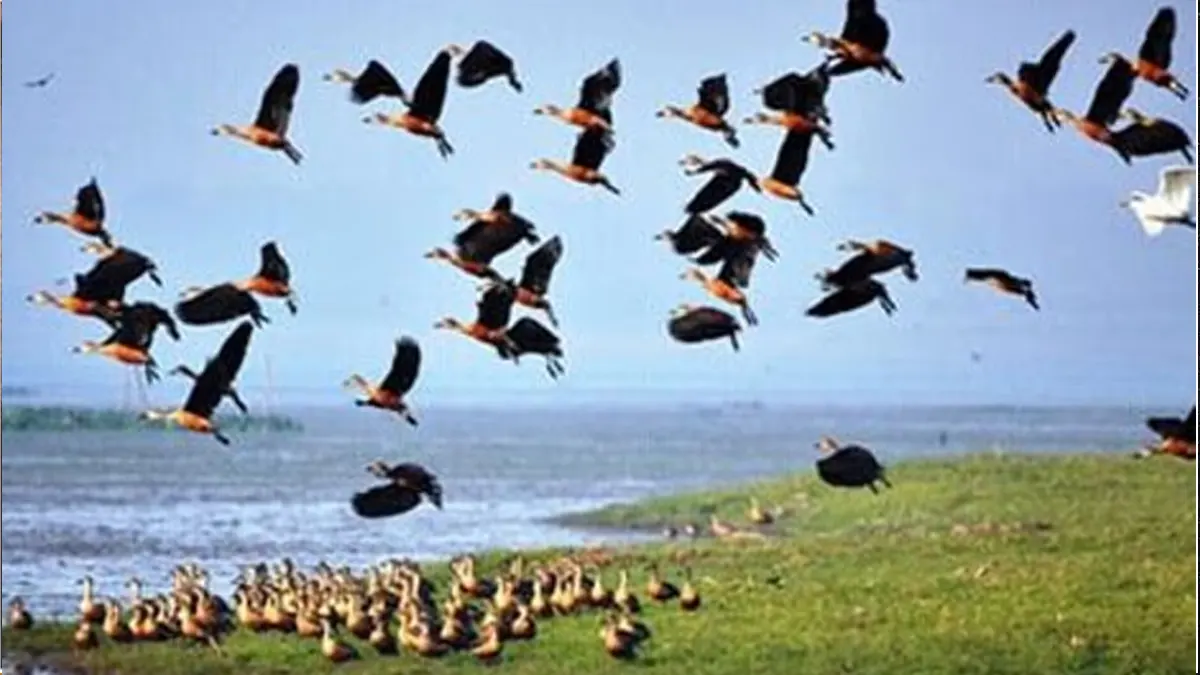
From Guwahati, a four-year bird monitoring study at Deepor Beel has brought cautious reassurance for one of the city’s most fragile ecological assets. The study finds that while waterbird numbers fluctuate sharply across seasons, the diversity of bird species has remained largely stable.
Researchers say the findings underline the importance of management practices and short-term human activities—rather than long-term ecological decline as the primary drivers behind changing bird counts at the Ramsar-listed wetland on Guwahati’s western edge.
A four-year study at Guwahati’s Deepor Beel has found that bird species diversity remains stable despite large seasonal fluctuations in waterbird numbers. Researchers say changes in bird counts are mainly driven by wetland management practices and short-term human activity, not loss of habitat diversity.
What the Study Found
The study, conducted between 2023 and 2026 by 7WEAVES in collaboration with government departments, universities, and local community groups, involved over 800 person-days of fieldwork.
Species counts recorded over the four years show remarkable consistency:
- 2023: 163 species
- 2024: 160 species
- 2025: 163 species
- 2026: 165 species
Researchers say this stability indicates that Deepor Beel continues to support a wide range of wetland habitats, despite pressures from urban expansion around Guwahati.
Fluctuating Numbers, Not Fading Diversity
While species diversity remained high, the number of birds present at peak times varied sharply.
- 2023: Peak congregation of 28,331 birds
- 2024: Peak dropped to 11,271 birds
The sharp decline in 2024 coincided with prolonged artificial control of water levels, researchers noted. In contrast, 2023 followed patterns closer to traditional, community-led water management, which supported larger congregations.
Why This Matters for Guwahati
For Guwahati, Deepor Beel is more than a wildlife site it is a natural flood buffer, biodiversity hotspot, and climate regulator located within the city’s expanding urban footprint.
Environmental experts in the city say the study reinforces a key message:
How Deepor Beel is managed matters as much as how much space it has.
Short-term interventions such as altered water regimes, construction activity, or disturbance during critical seasons can significantly affect bird numbers, even if habitats remain intact.
Community-Based Management in Focus
One of the study’s central conclusions is the value of traditional, community-based wetland management. Local fishing and water-use practices, refined over generations, appear to align more closely with ecological rhythms than centrally imposed controls.
Conservationists in Guwahati say this offers an important lesson for urban planning: protecting Deepor Beel may depend less on new rules and more on working with local knowledge systems.
Pressure Points Around the Wetland
Despite stable diversity, researchers caution that Deepor Beel remains vulnerable due to:
- Urban expansion from Guwahati
- Road and rail infrastructure along its periphery
- Short-term water manipulation
- Human disturbance during peak bird seasons
Unchecked, these factors could eventually erode the diversity that has so far remained resilient.
What Comes Next
Researchers have recommended:
- Minimising artificial water-level control
- Integrating community practices into formal management plans
- Monitoring human activity during critical migratory periods
For Guwahati’s planners and policymakers, the findings serve as a reminder that the city’s ecological future is closely tied to how Deepor Beel is treated today.
Frequently Asked Questions
Q1. Where is Deepor Beel located?
Deepor Beel is a Ramsar-listed wetland on the western edge of Guwahati.
Q2. Did the study find a decline in bird species?
No. Species diversity remained stable across four years, though the number of birds fluctuated seasonally due to management and human activity.