
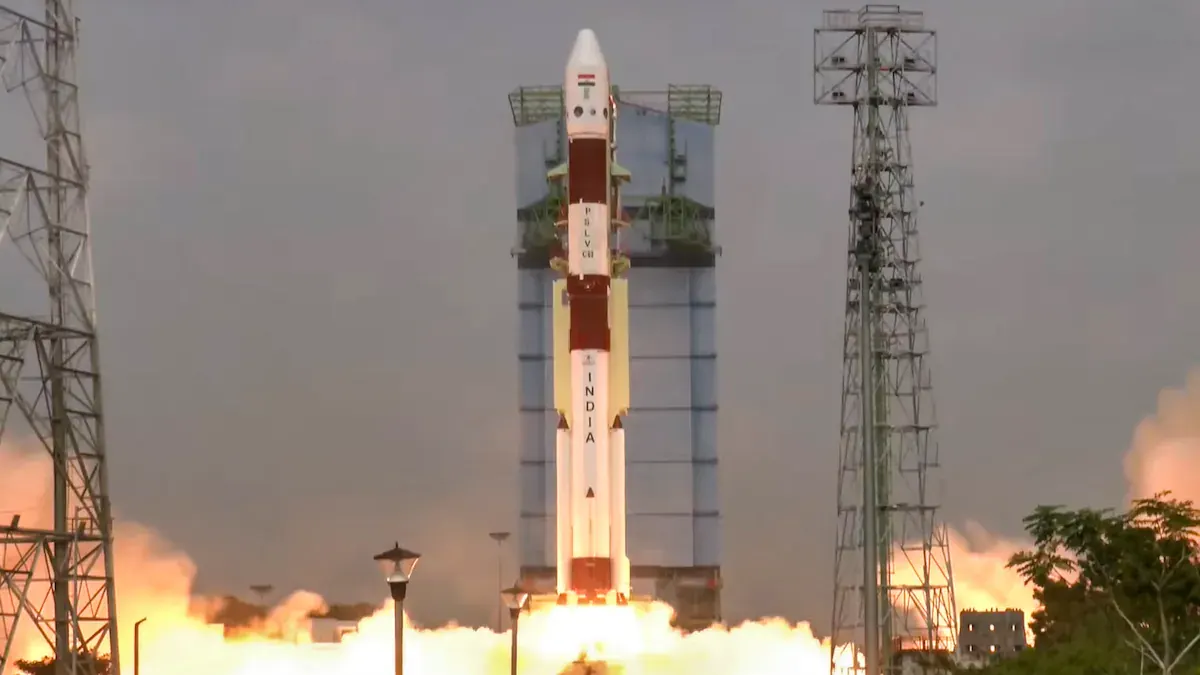
ISRO’s first orbital mission of 2026, PSLV-C62, has run into a technical setback, raising uncertainty over the orbital insertion of LACHIT-1, the first satellite developed from Northeast India. The student-built satellite, developed by Assam Don Bosco University near Guwahati, was among the payloads onboard the mission that encountered a third-stage anomaly.
While ISRO has confirmed the anomaly and initiated a detailed investigation, it has not yet officially clarified the final operational status of LACHIT-1 or other secondary payloads.
ISRO’s PSLV-C62 mission encountered a third-stage anomaly that prevented the rocket from following its planned trajectory. As a result, the orbital insertion of LACHIT-1, the first satellite from Northeast India developed by Assam Don Bosco University, remains unconfirmed pending ISRO’s investigation.
What Happened During PSLV-C62
According to ISRO, the PSLV-C62 mission encountered a flight anomaly at the end of its third stage (PS3). The deviation caused the launch vehicle to miss its intended flight path, and the mission did not proceed as originally planned.
Because of this, the satellites onboard could not be placed into their target orbits. ISRO has stated that it is analysing detailed flight data to determine the exact sequence of events that led to the failure.
LACHIT-1 and the Northeast’s First Satellite Effort
LACHIT-1 was developed by a 50-member student team from Assam Don Bosco University, with participation from students across the Northeast. The satellite was designed to demonstrate amateur radio communication and emergency messaging capabilities.
Named after Ahom general Lachit Barphukan, the project was widely seen as a milestone for Assam and Guwahati’s growing role in advanced science and technology education.
Mission Context and Payloads
PSLV-C62 was intended to carry:
- EOS-N1, an Earth observation satellite developed by DRDO
- About 16 satellites from Indian organisations and international partners
- LACHIT-1 as a secondary academic payload
EOS-N1 was designed as a hyperspectral satellite for advanced Earth monitoring and surveillance applications. Due to the anomaly, ISRO has indicated that EOS-N1 and other payloads may not have achieved a usable orbit.
Why the PSLV Setback Matters
The Polar Satellite Launch Vehicle is regarded as ISRO’s workhorse rocket, having launched many landmark missions such as Chandrayaan-1, the Mars Orbiter Mission, and Aditya-L1. Failures in PSLV missions are rare but closely scrutinised when they occur.
The previous PSLV mission, PSLV-C61 in 2025, had also failed due to a third-stage issue, making the C62 anomaly a matter of technical concern for ISRO.
Impact on Guwahati and the Northeast
For Guwahati and the wider Northeast, LACHIT-1 represented entry into India’s space ecosystem through student-led innovation. While the orbital outcome remains uncertain, experts note that the achievement of designing and qualifying a satellite for launch remains significant.
Academic institutions in Assam have described the project as a foundation for future space-tech participation, regardless of the mission’s final outcome.
What Happens Next
ISRO has said it will complete a full investigation into the PSLV-C62 anomaly and release its findings publicly. The agency has not yet confirmed the final status of individual satellites, including LACHIT-1.
Future missions in 2026, including additional PSLV launches, remain on ISRO’s schedule.
Why This Still Matters
Even amid uncertainty, LACHIT-1 stands as a landmark academic achievement for Assam. The mission highlights how student-driven innovation from Guwahati and the Northeast is now reaching national platforms, marking a shift in the region’s scientific ambitions.
Frequently Asked Questions
Q1. What went wrong with the PSLV-C62 mission?
ISRO confirmed a third-stage (PS3) anomaly that caused the rocket to deviate from its planned trajectory, preventing proper orbital insertion.
Q2. Has ISRO confirmed the fate of LACHIT-1?
No. ISRO has not yet officially confirmed the final orbital or operational status of LACHIT-1 and other payloads.